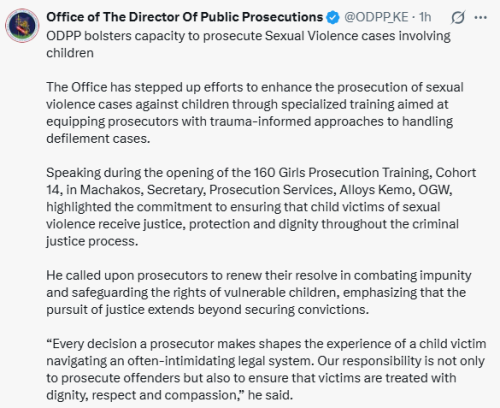
ODPP intensifies fight against child sexual violence through specialised prosecutors’ training
By Ndiritu Wanjiru, June 24, 2026The Office of the Director of Public Prosecutions (ODPP) has strengthened its efforts to improve the prosecution of sexual violence cases involving children through specialised training aimed at enhancing prosecutors’ capacity to handle defilement cases using trauma-informed approaches.
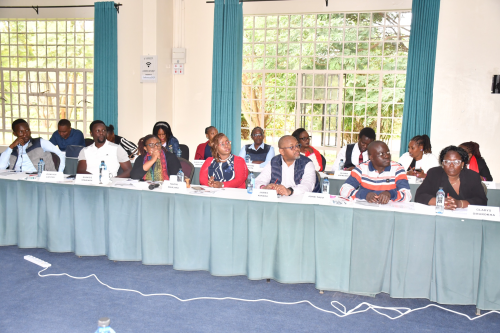
Speaking during the opening of the 160 Girls Prosecution Training, Cohort 14, in Machakos on Wednesday, June 24, 2026, the Secretary for Prosecution Services, Alloys Kemo, underscored the ODPP’s commitment to ensuring that child victims of sexual violence receive justice, protection, and dignity throughout the criminal justice process.
Kemo has urged prosecutors to renew their commitment to tackling impunity and protecting the rights of vulnerable children, noting that the pursuit of justice goes beyond securing convictions.
“Every decision a prosecutor makes shapes the experience of a child victim navigating an often-intimidating legal system. Our responsibility is not only to prosecute offenders but also to ensure that victims are treated with dignity, respect and compassion,” Kemo said.
ODPP has noted that the training forms part of ongoing efforts by the ODPP to equip prosecutors with the skills needed to effectively handle sensitive cases involving child victims while minimising the risk of re-traumatisation during legal proceedings.
The programme is expected to strengthen the justice system’s response to sexual violence against children by promoting victim-centred prosecution practices and improving access to justice for survivors.
Violence against children includes all forms of violence against people under 18 years old, whether perpetrated by parents or other caregivers, peers, romantic partners, or strangers.
WHO report on violence against children
According to a global report released by the World Health Organisation (WHO) on May 7, 2026, it is estimated that up to 1 billion children aged 2–17 years have experienced physical, sexual, or emotional violence or neglect in the past year.
According to the health organisation, experiencing violence in childhood impacts lifelong health and well-being.
WHO, in its report, further noted that the target of the 2030 Agenda for Sustainable Development is to end abuse, exploitation, trafficking and all forms of violence against and torture of children.
WHO noted that evidence from around the world shows that violence against children can be prevented.
The organisation stated that preventing and responding to violence against children requires that efforts systematically address risk and protective factors at all four interrelated levels of risk (individual, relationship, community, and society).