NTSA explains why traffic instant fines must be done physically
By Aloys Michael, July 1, 2026The National Transport and Safety Authority (NTSA) has broken its silence on why motorists are required to pay instant traffic fines physically at Kenya Commercial Bank branches rather than through the more convenient eCitizen platform.
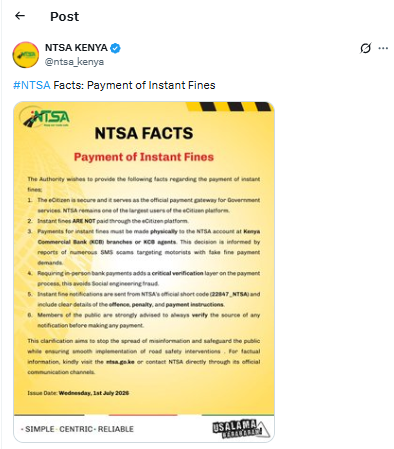
In a public advisory issued on Wednesday, July 1, 2026, the Authority provided a detailed explanation, citing rising cases of SMS fraud targeting motorists as the primary reason for the requirement. The clarification comes amid growing public confusion and criticism over the payment process.
“Instant fines ARE NOT paid through the eCitizen platform. Payments for instant fines must be made physically to the NTSA account at Kenya Commercial Bank branches or KCB agents,” the authority stated.
NTSA has emphasised that while eCitizen remains secure and serves as the official payment gateway for Government services, the decision to exclude instant fines was deliberate.
“This decision is informed by reports of numerous SMS scams targeting motorists with fake fine payment demands,” the notice reads.
NTSA Director General Nashon Kondiwa, in an interview on a local TV station, elaborated on the rationale, explaining that the authority was aware of potential loopholes before launching the automated system.
“The reason why we are not using eCitizen is because of fraud. When it is M-Pesa, confusing someone is very easy, so we are having a second layer before people pay,” Kondiwa said.
He further explained that the physical interaction adds a critical verification step to protect motorists.
“Out of an abundance of caution, and just to protect Kenyans, we added the other layer of physical interaction,” he said. “If you go there, you will find a reference reflected in the bank system so that you are not paying money to an account without another check.”
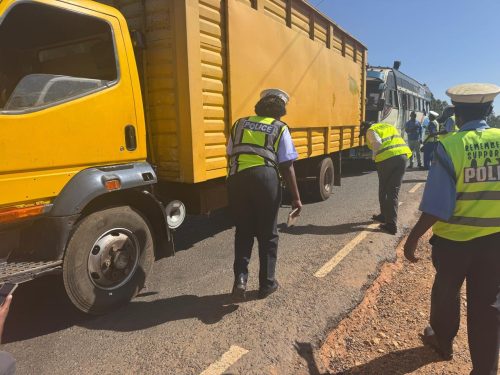
The issue came into the spotlight on Monday after city lawyer Donald Kipkorir revealed on X that his younger brother had been flagged for a speeding violation and paid the fine at a KCB branch in Nairobi.
However, Kipkorir questioned why the payment notification indicated that the money had been deposited into a private account rather than a government treasury account.
“Unless NTSA publicly responds to this, then we will assume that they are part of a scheme to defraud Kenyans. Why should public funds be deposited in a private account?” Kipkorir posed.
Addressing the concern, Kondiwa acknowledged the anomaly and confirmed investigations were underway.
“There is a mistake that was made there… immediately I contacted KCB and I really asked them to investigate this and give me the full disclosure,” he said.
Kondiwa was also challenged on why similar physical verification is not required for other government services such as passport applications or driving licence renewals.
Tackling scam
He explained that those services are fundamentally different because applicants first submit identification documents and complete the transaction within a secure government platform.
“In this other one, the initial communication that triggers you to pay is an SMS, totally outside the platform and that’s what fraudsters are trying to do,” Kondiwa said.
“The fraudsters are trying to hijack that process by sending you a fake SMS so that you click and pay. If ours was also click and pay, then we would be playing into the hands of these fraudsters.”
According to the NTSA notice, official instant fine notifications are sent from the Authority’s official short code 22847_NTSA and include clear details of the offence, penalty, and payment instructions. The public has been strongly advised to always verify the source of any notification before making any payment.
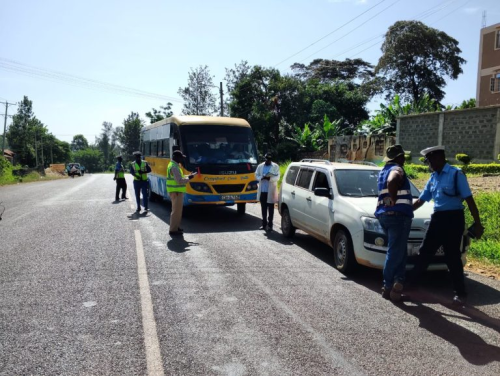
/X.
“Requiring in-person bank payments adds a critical verification layer on the payment process, this avoids Social engineering fraud,” the notice states.
The Authority maintains that the physical verification requirement, while less convenient, is a necessary safeguard. “For us to choose this route, it means that while introducing this product to the market, we were aware of all the loopholes,” Kondiwa said.
“When introducing a new product to the market, you design what we call the customer journey and, to protect the customer, you look at the possible fraud elements.”
NTSA has urged the public to seek factual information through its official website ntsa.go.ke or contact the Authority directly through its official communication channels.
“This clarification aims to stop the spread of misinformation and safeguard the public while ensuring smooth implementation of road safety interventions,” the authority said.