NEMA receives critical report on plans to rebuild Nairobi Railway Central Station
By Kiprono Keileb, December 16, 2025Kenya’s ambitious plan to redevelop the Nairobi Central Station has cleared a major regulatory hurdle, after the National Environment Management Authority (NEMA) confirmed it has received and reviewed an Environmental Impact Assessment (EIA) Study Report for the proposed project.
The approval paves the way for Kenya Railways Corporation (KRC) to regenerate the historic Nairobi Central Station into a modern, iconic city-centre transport hub aimed at improving passenger access, capacity and overall urban mobility. The redevelopment will include two-level station buildings, new entrances and exits, upgraded platforms and canopies, footbridges, and a range of supporting public amenities within Nairobi County.
According to the notice published in MyGov’s weekly gazette dated Tuesday, December 16, 2025, NEMA’s green light comes with extensive environmental and social safeguards that contractors must strictly follow throughout construction and operation.
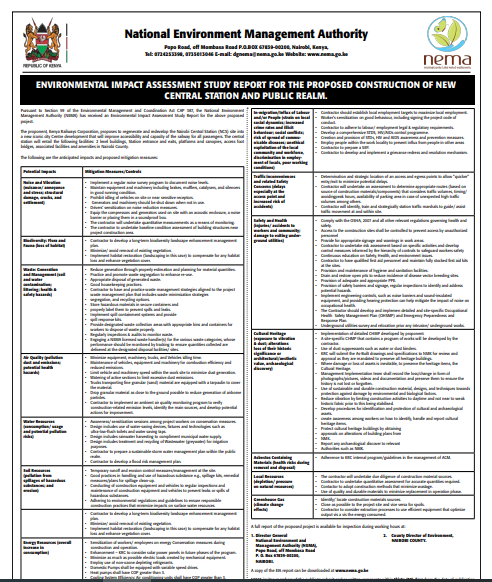
“Pursuant to Section 59 of the Environmental Management and Coordination Act, CAP 387, the National Environment Management Authority (NEMA) has received an Environmental Impact Assessment Study Report for the proposed construction of the new Central Station and public realm,” the authority stated.
The regulator noted that the project is expected to significantly reshape Nairobi’s urban landscape, but warned that careful management is required to prevent harm to nearby communities, heritage assets and the environment.
Measuring noise levels
On noise and vibration, NEMA said contractors must regularly measure noise levels, properly maintain machinery, avoid unnecessary idling of vehicles, and conduct baseline assessments of nearby buildings to prevent structural damage.
“The proponent, Kenya Railways Corporation, proposes to regenerate and redevelop the Nairobi Central Station site into a new iconic city centre development that will improve accessibility and capacity of the railway for all passengers,” NEMA said in the notice.
Vegetation removal and waste management
Environmental protection forms a central pillar of the approval. Contractors will be required to minimise vegetation removal, restore habitats through landscaping, and implement a long-term biodiversity enhancement plan to compensate for any habitat loss.
Waste management rules are equally strict. NEMA directed that waste be reduced at source, segregated for reuse or recycling, and handled only by licensed waste collectors. Hazardous materials must be securely stored and labelled, with spill response systems in place to prevent soil and water contamination.

“The main objective is to provide clear mitigation measures to promote equity and sustainability while ensuring responsible construction practices,” the authority stated.
Air quality controls will include dust suppression through watering, covering of loose materials during transport, speed limits for construction vehicles, and regular monitoring of emissions. Water conservation measures such as rainwater harvesting, wastewater recycling for irrigation, and stormwater and flood management plans are also mandatory.
Livelihood restoration and cultural heritage
The approval also addresses social impacts. Kenya Railways must implement livelihood restoration plans for affected businesses, prioritise local employment, and put in place grievance resolution mechanisms to address community concerns. Traffic marshals will be deployed to manage congestion and reduce accident risks around the site.
NEMA further emphasised protection of cultural heritage, directing that any alterations to historic structures be approved by the National Museums of Kenya and that any archaeological discoveries be reported immediately.
With these conditions in place, the Nairobi Central Station rebuild is expected to move forward as one of the capital’s most closely regulated infrastructure projects, balancing modernisation with environmental protection and community welfare.