Advertisement
Negotiators face tough task on climate finance roadmap
Wednesday 25th June, 2025 09:20 AM|
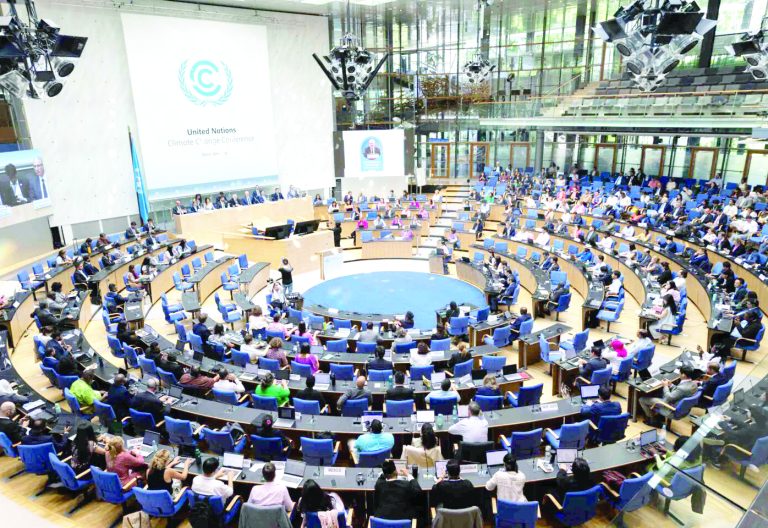
The United Nations expects climate negotiators in Bonn, Germany, to clearly define a roadmap to boost climate finance for developing countries, so that it can be finalised at the climate summit (COP30) in Belém, Brazil.
However, there is still a wide gulf between governments, multilateral development banks and civil society on how to raise US$1.3 trillion a year by 2035.
The mid-year UN climate conference in Bonn, laying the groundwork for this year’s climate summit in Brazil, started slowly with negotiators wrangling over the agenda. As witnessed in recent UN conferences of the parties (COPs), climate finance is a thorny issue at the talks in Bonn, which end tomorrow.
Wrangles on the agenda ensued as developing countries formally requested discussions on the implementation of Article 9.1 of the Paris Agreement, on finance provided by rich nations, and climate change-related unilateral trade measures.
You Might Also Like

After the two items proposed by developing countries on climate finance and unilateral trade measures, which saw wide resistance from developed countries, were included in the agenda of the Bonn talks, focus turned to the New Collective Quantified Goal (NCQG)- a key outcome that nations agreed on at COP29 in Baku, Azerbaijan.
NCQG offers US$300 billion per year to finance climate action for developing countries, for which developing countries take the lead in mobilisation.
The new finance goal was nested with a larger goal of US$1.3 trillion by 2035, which could come from various sources including the private sector and contributions from diverse sources and contributions from willing developing countries.
Predictable financing
However, the decision offered only ‘mobilisation’ of finance – using public money to crowd in private money or directing funds from other sources.
Article 9.1 was neglected in the Baku decision since developed countries decided to shirk their obligations directly to provide public funds to developing countries – a source with more predictability and accountability than private finance.
Bolivia (on behalf of least developed countries) and India have expressed disappointment with the reluctance of developed countries to discuss their obligation to provide finance and vowed to return to the item on Article 9.1 at COP30, with Nigeria referring to it as speaking “to the blood of the UN Framework Convention on Climate Change (UNFCCC)”.
Climate negotiators in Bonn have been tasked with taking a “deep dive” into how a roadmap to boost climate finance should look, so that it can be finalised at COP30 in Brazil – but a series of consultations last week revealed that governments have yet to align its contents, writes Tais Gadea Lara in the latest issue of the authoritative UK-based Climate Home News digital publication.
At the start of the mid-year talks in Bonn, UN climate chief Simon Stiell advised governments that the roadmap for mobilising US$1.3 trillion a year by 2035 should not be just a report but a how-to guide with clear next steps on dramatically scaling up climate finance and investment.
“That will mean reconciling divergent views among countries about what sources of finance the roadmap should draw on – and what form the money should come in. Some delegates in Bonn have also complained that the process for compiling the roadmap is unclear,” writes Lara.
The “Baku to Belem Roadmap to 1.3T” was launched as part of the new climate finance goal (the NCQG) agreed at COP29, with a commitment for donors to raise US$300 million annually, largely from the public purse, at its core.
Climate Finance Group for Latin America and the Caribbean (GFLAC) director-general Sandra Guzmán told Climate Home the roadmap emerged “as a way to reduce the gap” between the US$300 billion developed countries have committed to mobilise by 2035 and the far higher amount developing countries were asking from, of US$1-1.3 trillion.
“It was also a kind of exit plan to prevent the NCQG discussion from moving to Belem,” she noted.
The two COP presidency teams charged with drafting the roadmap – Azerbaijan and Brazil – last week listened to the needs and concerns of governments in Bonn in the first formal consultations on the roadmap since COP29 in Baku.
One main unresolved rift is that developing countries wanted the US$1.3 trillion to consist of public money from rich nations but according to the text agreed in Baku, all sources of finance are possible with no percentage distribution between them specified.
Climate Action Network International global advocacy lead Rebecca Thissen told Climate Home the broad scope of proposals on the roadmap from countries in Bonn shows clearly that “we don’t have a common understanding of what it is and what we’re going to do with it”.
Supplementary effort
In general, developing countries have requested that the US$1.3 trillion should consist of new money that is not re-labelled from other budgets, with public grant money as the bulk of it, excluding loans and other forms of debt.
India, for its part, has said that global tax levies and approaches to raise money from specific sectors should be excluded, even though a recent survey by Greenpeace and Oxfam shows that 80 per cent of respondents in India agreed that oil, gas and coal corporations should be taxed for the environmental damage they have caused.
During last week’s discussions, a delegate from the Independent Alliance of Latin America and the Caribbean said: “The engagement of private sector and philanthropic institutions must complement and not replace the obligations of developed countries”.
In contrast, the European Union’s representatives argued: “We should really focus on scaling up private finance and catalysing investments that drive climate action”. They also called on other countries to join the pool of donors mobilising money – referring to China and Gulf nations.
From the 116 submissions on the roadmap received ahead of the Bonn talks, only 20 were from governments, with the rest from civil society, including NGOs, research organisations and businesses.
At a consultation for these non-governmental groups, Ainash Persaud, special adviser on climate change for the president of the Inter-American Development Bank, presented a plan to achieve the US$1.3 trillion goal.
Under it, multilateral development banks would buy existing private-sector loans to renewable energy projects in poor countries, with commercial lenders then using the proceeds for more clean energy investment.
Guzmán said the private sector should play a bigger role, but it is still unclear how the roadmap would avoid perpetuating the existing model of largely debt-based climate finance, nor who would benefit – as countries like Brazil and Tuvalu do not have the same needs.
The two COP presidencies are tasked with preparing the roadmap, whose form is still being decided, but need to present ideas for how the US$1.3 trillion can be raised.
COP30 CEO Ana Toni told Climate Home in Bonn that it will include recommendations on how to move forward.
A first draft of the report is expected to be presented for comment in September, with the final version published in October.
Author
Alberto Leny
View all posts by Alberto LenyLatest News



Advertisement
More on News