Ndindi Nyoro proposes measures to ease fuel prices
By Mustafa Juma, May 15, 2026Kiharu Constituency Member of Parliament (MP) Ndindi Nyoro has unveiled a set of proposals aimed at significantly reducing fuel prices in Kenya through a combination of tax reforms, subsidies, and margin reductions.
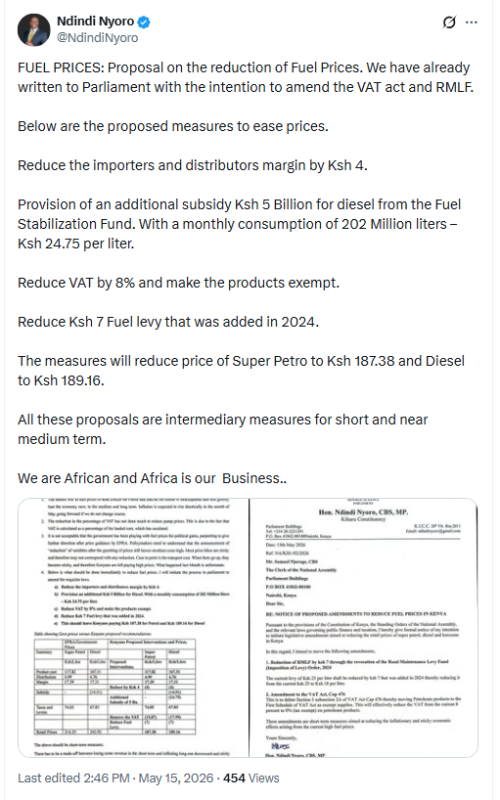
In a press statement issued on Friday, May 15, 2026, Nyoro argued that the proposals, which he says have already been forwarded to Parliament, seek to amend the VAT Act and the Road Maintenance Levy Fund (RMLF) framework as part of short and medium-term measures to ease the cost of living.
Proposed fuel price reduction measures
In his statement, Nyoro outlined several interventions he believes could immediately lower pump prices across the country.
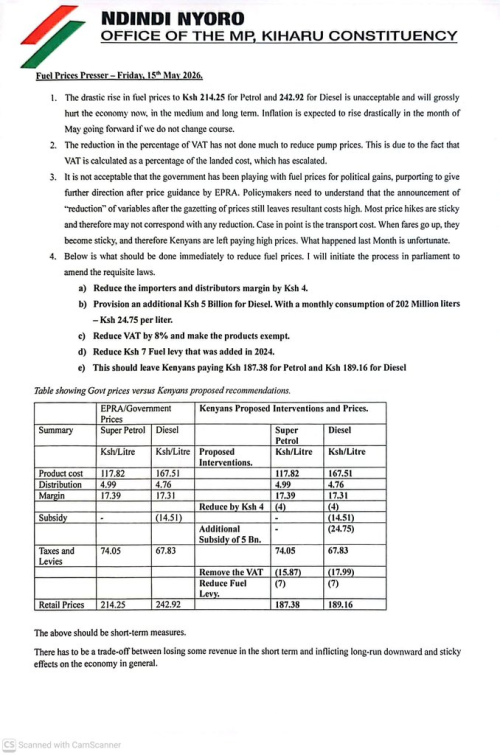
Among the key proposals are the reduction of importers’ and distributors’ margins by Ksh4, the introduction of an additional Ksh5 billion subsidy for diesel through the Fuel Stabilisation Fund, the reduction of VAT by 8% and making of fuel products VAT-exempt, and the removal of the Ksh7 fuel levy introduced in 2024.
He said the measures are designed to address both taxation and supply-side costs that contribute to high fuel prices in the country.
“FUEL PRICES: Proposal on the reduction of Fuel Prices. We have already written to Parliament with the intention to amend the VAT act and RMLF. Below are the proposed measures to ease prices.Reduce the importers’ and distributors’ margin by Ksh 4. Provision of an additional subsidy of Ksh 5 Billion for diesel from the Fuel Stabilization Fund. With a monthly consumption of 202 Million liters – Ksh 24.75 per litre. Reduce VAT by 8% and make the products exempt. Reduce Ksh 7 Fuel levy that was added in 2024,” Nyoro said in a statement shared via his official X account.
Expected impact on pump prices
According to Nyoro, if implemented, the proposals would significantly reduce fuel prices at the pump.
He projected that Super Petrol could drop to Ksh187.38 per litre, while diesel could fall to Ksh189.16 per litre.
“The measures will reduce price of Super Petro to Ksh 187.38 and Diesel to Ksh 189.16. All these proposals are intermediary measures for short and near medium term,” he noted.
Fuel prices hike shocker
Fuel prices in Kenya have remained a major political and economic issue, influencing transport costs, food prices, and overall inflation.
Motorists will pay more for fuel in the latest monthly review by the Energy and Petroleum Regulatory Authority despite the government injecting billions of shillings in subsidies to cushion consumers from a sharper increase.
According to the pricing breakdown released by EPRA for the period between May 15 and June 14, 2026, the government was forced to absorb part of the actual fuel costs through the Price Stabilisation mechanism, particularly on diesel and kerosene.
“The Government will, in this cycle, cushion the consumers through the Petroleum Development Levy (PDL) Fund by utilising approximately Ksh. 5 billion to subsidise the prices of Diesel and Kerosene,” EPRA stated.

Kenyans should brace for even tougher times as the government increases retail prices for a litre of diesel and super petrol by Ksh46.29 and Ksh16.65, respectively.
The new prices are likely to push up production and transportation costs, a move likely to see manufacturers pass the increased bill to consumers.
The latest increase reverses last month’s relief at the pump, when motorists benefited from reduced fuel prices after the government lowered Value Added Tax (VAT) on petroleum products from 16 per cent to eight per cent through Legal Notice No. 70 issued on April 15, 2026.
During the previous cycle, Super Petrol retailed at Ksh197.60 per litre in Nairobi, while diesel sold at Sh196.63 after reductions of Ksh9.37 and Ksh10.21 respectively.
Higher fuel prices are expected to push up transport costs, food prices, electricity production costs and also the cost of goods and services.