NCPB takes over seed subsidy function from Kenya Seed Company
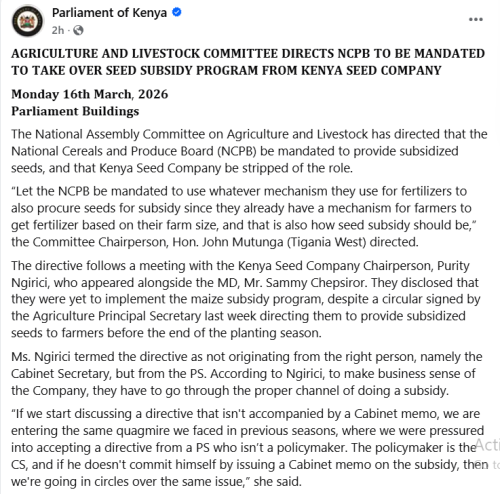
By Faith Lagat, March 17, 2026The National Cereals and Produce Board (NCPB) has been directed to assume responsibility for the maize seed subsidy program from the Kenya Seed Company, following a session by the National Assembly Committee on Agriculture and Livestock on March 16, 2026.
The move aims to streamline the distribution of subsidised seeds amid the ongoing planting season and ensure farmers receive inputs on time.
Committee Chairperson John Mutunga (Tigania West) instructed NCPB to use its existing fertiliser distribution framework, which registers farmers based on farm size and works with counties for last-mile delivery, to also manage seed subsidies.
“Let the NCPB be mandated to use whatever mechanism they use for fertilisers to also procure seeds for subsidy since they already have a mechanism for farmers to get fertiliser based on their farm size, and that is also how seed subsidy should be,” he said.
Delays and pricing concerns
The directive follows delays in implementing the maize seed subsidy. Last week, Agriculture Principal Secretary Kipronoh Ronoh issued a circular requiring Kenya Seed Company to offer subsidised maize seeds at Ksh 250 per kg, with scaled prices for larger quantities, backed by Ksh 2 billion from the FY 2025/26 Supplementary Budget.
Kenya Seed Company Chairperson Purity Ngirici and Managing Director Sammy Chepsiror told the committee that they had not yet acted, arguing the directive lacked proper authorisation through a Cabinet memo. Ngirici noted that the subsidised price was below the production cost of Ksh 257.40 per kg, which could result in a loss of about Ksh 7.40 per kg if implemented.
Committee pushes for immediate action
Lawmakers pressed for swift execution to protect farmers. David Kiplagat (Soy) urged that both fertiliser and seed subsidies be routed through, which could source from Kenya Seed and ensure timely distribution.
Brighton Yegon supported the approach, noting that seeds and fertilisers complement each other and NCPB’s established system would reach more farmers efficiently.
With the planting season already 60 percent complete, the committee proposed using part of the Ksh 2 billion allocation to clear last year’s Ksh 1.4 billion pending bill to Kenya Seed, with the remainder going to NCPB for immediate distribution.
The decision reflects parliamentary oversight aimed at enhancing food security by ensuring timely access to inputs for maize production. By leveraging NCPB’s infrastructure, the move seeks to reduce delays, reach more farmers, and support timely planting, despite concerns raised over pricing and policy authorisation by Kenya Seed Company.