National Assembly Committees to review privatisation plan for Kenya Pipeline Company
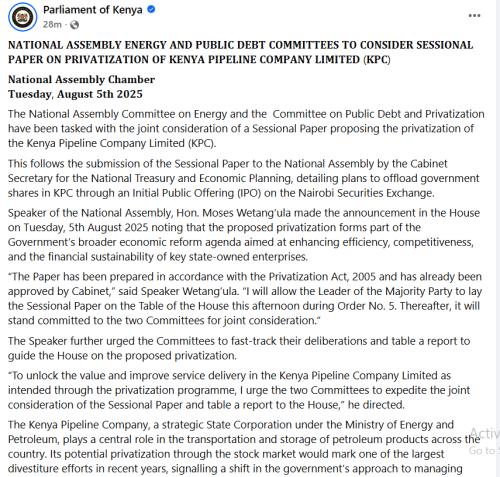
By Faith Lagat, August 5, 2025The National Assembly’s Energy Committee and the Committee on Public Debt and Privatisation have been assigned to jointly review a Sessional Paper proposing the privatisation of the Kenya Pipeline Company Limited (KPC).
The move was announced by Speaker of the National Assembly Moses Wetang’ula during a plenary session on Tuesday, August 5, 2025.
It marks a significant step in the government’s broader economic reform agenda aimed at enhancing efficiency and financial sustainability within state-owned enterprises.
“The National Assembly Committee on Energy and the Committee on Public Debt and Privatisation have been tasked with the joint consideration of a Sessional Paper proposing the privatisation of the Kenya Pipeline Company Limited (KPC),” read part of the Parliament of Kenya posts on Facebook.
Govt eyes IPO
The Sessional Paper, submitted by the Cabinet Secretary for the National Treasury and Economic Planning, outlines plans to sell a portion of government shares in KPC through an Initial Public Offering (IPO) at the Nairobi Securities Exchange.
According to Speaker Wetang’ula, the paper complies with the provisions of the Privatisation Act, 2005, and has already been approved by Cabinet. “I will allow the Leader of the Majority Party to lay the Sessional Paper on the Table of the House this afternoon during Order No. 5,” he said. “Thereafter, it will stand committed to the two committees for joint consideration.”
The proposed IPO is expected to reduce the government’s fiscal burden while improving KPC’s operational efficiency and financial performance.
KPC remains key
Established under the Ministry of Energy and Petroleum, KPC plays a vital role in the transportation and storage of petroleum products across the country. Its potential listing on the stock exchange would mark one of the largest divestitures in recent years and signal a shift toward market-driven management of profitable state corporations.
Privatising such a strategic asset has drawn both interest and concern. While proponents believe the move could unlock value and attract private investment, some stakeholders have raised fears about job losses and potential increases in fuel transport costs.
Public engagement
Wetang’ula directed the committees to expedite their review and table a report to guide parliamentary debate. He emphasised the need for a transparent and inclusive process that incorporates public participation and engagement with relevant stakeholders.
“This is a bold step, but it must be handled carefully to protect public interest,” said Jane Okoth, an energy policy analyst.
The outcome of the joint review will shape the future of KPC and set a precedent for future privatisation efforts involving other state-owned enterprises.