Advertisement
Nairobi outlines mandatory rules before constructing on land near rivers
Tuesday 05th May, 2026 01:13 AM|

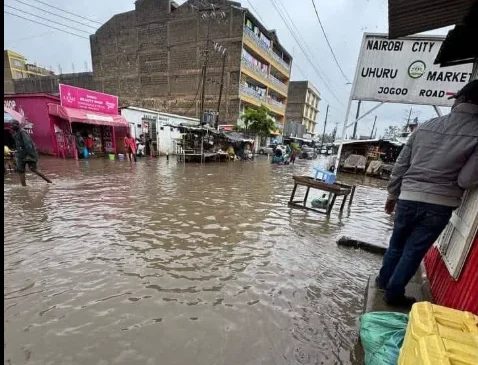
Nairobi County has issued a warning to developers and property owners encroaching on riparian reserves as flooding continues to affect parts of the city and other regions in Kenya.
Patrick Analo, Chief Officer for Urban Development and Planning at Nairobi County, speaking during an interview on Monday night, May 4, 2026, said the law requires developers to obtain clearance from the Water Resources Authority before commencing construction on riverfront plots.
“The law requires that if you own a plot that fronts a river, before you commence construction, you must get clearance from the Water Resource Authority, and they do what we call pegging,” he said.
He noted that earlier survey plans, particularly before 1996, clearly indicated riparian distances on land titles. He added that violations often occur during construction despite initial approvals being in place.
You Might Also Like



“You find people have approvals with the right distances from the river, but during construction, they exceed what is allowed. Those which are found to have violated the approvals will have to pay the consequences,” he said.
Riparian enforcement and flooding response
The Nairobi River Commission says it is working with a multi-agency team to identify and manage developments within riparian zones. Commissioner Mumo Musuva said mapping exercises have been completed in several affected areas, with enforcement notices already issued.
“There is a lot of impunity when it comes to matters of land, and the rivers have suffered a lot because of that,” Musuva said.
He added that more than 300 notices have been issued along the Nairobi River and its tributaries, including Kirichwa Kubwa, with further action expected in Kirichwa Ndogo, Mathare, Parklands, and Ngong River sections. He also said public participation and due process remain key in ongoing enforcement.
National oversight and infrastructure concerns
The flooding situation has also been raised at the National Assembly, where the Environment, Forestry and Mining Committee questioned environmental and planning agencies over drainage systems, sewerage infrastructure, and illegal developments.
Committee Chair Vincent Musyoka said enforcement agencies must take responsibility for approving unlawful structures.
“This appears a NEMA issue, however, planning and the behaviour of the people of Nairobi come in. NEMA can’t run away… you approve illegal buildings,” he said.
Lawmakers called for stronger action against encroachment on riparian land, including demolition of illegal structures.
NEMA Director-General Mamo Mamo cited ageing infrastructure, informal settlements, and poor waste management as contributing factors to flooding, noting coordination with the Nairobi River Commission on relocations.
Governor Johnson Sakaja described the flooding as a long-standing challenge linked to Nairobi’s geographical setup, while confirming ongoing rescue operations in affected areas. The death toll from recent flooding has risen, with several fatalities reported in Nairobi and other parts of the country.
Authorities continue to urge compliance with riparian regulations as heavy rains persist across multiple regions, and enforcement is being intensified to restore river buffers and reduce risks linked to construction along waterways.
Author
Latest News





Advertisement
More on News