Muturi raises alarm over 973K ghost learners in NEMIS audit
By Faith Lagat, April 7, 2026Former Attorney General and Democratic Party of Kenya (DP) leader Justin Muturi has expressed serious concerns over a recent National Education Management Information System (NEMIS) audit, which revealed approximately 973,000 “ghost learners” in Kenyan schools.
The audit, carried out by the Ministry of Education across all 47 counties, found significant mismatches between NEMIS records and actual learners on the ground.
Primary schools showed a shortfall of roughly 885,904 learners, while secondary schools were over-reported by about 87,730. Additionally, 27 schools (10 secondary and 17 primary) listed in the system were found to be non-operational.
The irregularities reportedly caused losses of hundreds of millions of shillings in capitation funds, with the government saving an estimated Ksh912 million in the third term of 2025 after corrective measures.
“The recent audit by National Education Management Information System (NEMIS) revealing approximately 973,000 “ghost learners” is a matter of grave national concern,” Muturi stated.
Data integrity and national risks
Muturi highlighted that NEMIS relies heavily on foundational identity records, such as birth registrations, and argued that the large number of irregular entries points to deeper systemic weaknesses in data capture, validation, and coordination across agencies.
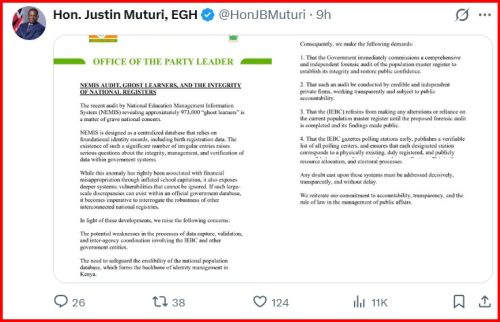
“If such large-scale discrepancies can exist within an official government database, it becomes imperative to interrogate the robustness of other interconnected national registries,” the statement read.
He warned that these vulnerabilities could extend beyond the education sector, potentially undermining the credibility of the national population master register, public resource allocation, identity verification, and electoral processes overseen by the Independent Electoral and Boundaries Commission (IEBC).
Calls for independent forensic audit
In response, Muturi made several demands: the government should commission an independent forensic audit of the population master register, conducted transparently by credible private firms; the IEBC must refrain from altering or relying on the current register until the audit is completed; polling stations should be gazetted early with a verifiable, accessible list; and Parliament and oversight bodies should supervise the process to ensure independence and credibility.
Muturi emphasised that Kenya’s democratic stability relies on trustworthy data systems underpinning identity, public spending, and elections.
“Any doubt cast upon these systems must be addressed decisively, transparently, and without delay,” he stated, reaffirming the Democratic Party’s commitment to accountability and the rule of law.
The NEMIS revelations have already led the Education Ministry to order disciplinary and potential criminal proceedings against implicated officials.