Muturi calls for forensic audit of Kenya’s identity database amid voter register integrity concerns
By Ndiritu Wanjiru, June 17, 2026Former Public Service Cabinet Secretary and ex-Attorney General Justin Muturi has renewed calls for an independent forensic audit of Kenya’s population registration and identity management systems.
Muturi argues that concerns over the integrity of citizenship records extend beyond the mandate of the Independent Electoral and Boundaries Commission (IEBC).
Muturi, on Wednesday, June 17, 2026, acknowledged a recent position by IEBC, arguing that the debate should focus on the authenticity of the foundational identity records used during voter registration rather than the registration process itself.
“The reality is that the IEBC registers voters primarily based on a national identity card or a valid Kenyan passport. The Commission does not create citizenship records, issue identity documents, or independently determine the authenticity of the foundational data upon which those documents are based,” Muturi said.
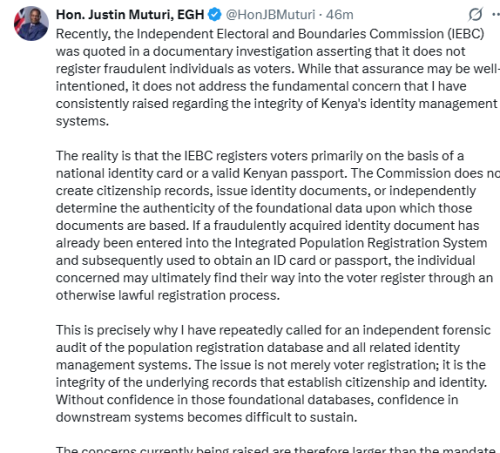
According to Muturi, an individual who obtains a national identity card or passport through fraudulent means may still be legally registered as a voter if those documents have already been entered into the country’s official identity management systems.
Forensic audit
He noted that this possibility underscores the need for a comprehensive audit of the Integrated Population Registration System (IPRS) and related databases responsible for citizenship and identity verification.
“The issue is not merely voter registration; it is the integrity of the underlying records that establish citizenship and identity. Without confidence in those foundational databases, confidence in downstream systems becomes difficult to sustain,” he added.
Muturi emphasised that the concerns raised go beyond the electoral commission and involve institutions responsible for immigration, citizenship registration, and identity management.
He warned that any weaknesses within these systems could have far-reaching implications for public trust, national security, and the credibility of government services.
“The answer is neither denial nor political rhetoric, but transparency, independent verification, and accountability,” he said.
The former attorney general has further argued that a forensic audit would help strengthen public institutions rather than undermine them. He maintained that if the systems are functioning as intended, an audit would reassure Kenyans and restore confidence in the country’s identity management framework.
Conversely, Muturi has noted that any vulnerabilities uncovered could be addressed before they affect future elections or public service delivery.
Muturi further described the integrity of citizenship records as a matter of national security, urging authorities to treat the issue with the seriousness it deserves.