Advertisement
MPs raise alarm over Ksh50B VAT refund backlog at KRA
Friday 22nd May, 2026 03:57 PM|

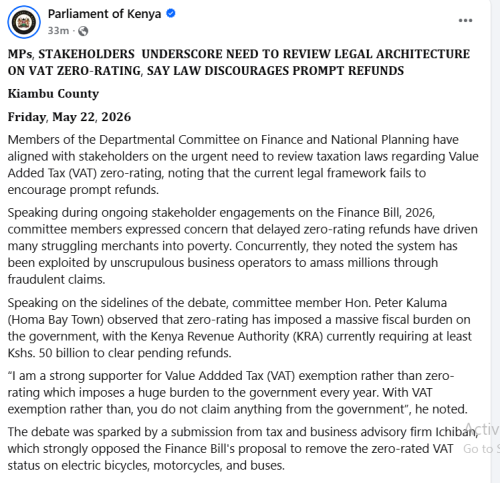
Members of Parliament have raised concerns over a Ksh50 billion Value Added Tax (VAT) refund backlog at the Kenya Revenue Authority (KRA), citing weaknesses in the current taxation framework and delays that continue to affect businesses across the country.
During stakeholder engagements on the Finance Bill 2026, the Departmental Committee on Finance and National Planning noted that the existing VAT zero-rating system does not adequately support prompt refunds or prevent misuse, creating pressure on public finances and businesses awaiting payments.
Peter Kaluma (Homa Bay Town) supported a shift from VAT zero-rating to VAT exemption.
“I am a strong supporter of Value Added Tax (VAT) exemption rather than zero-rating, which imposes a huge burden on the government every year. With VAT exemption, rather than you do not claim anything from the government,” he noted.
You Might Also Like


The discussions were prompted by submissions opposing the proposed removal of zero-rated VAT status on electric bicycles, motorcycles, and buses, with stakeholders warning of implications for the growing e-mobility sector.
Concerns over VAT system
Tax advisory firm Ichiban reported that Kenya’s electric mobility sector has expanded significantly, with registrations increasing from 1,378 units in 2022 to 39,324 in 2025. The firm noted that electric motorcycles now account for 15 percent of new bike registrations.
Session Chair David Mboni supported continued investment in e-mobility but acknowledged challenges in the VAT refund system. Committee member Julius Rutto (Kesses) said delays were partly due to inadequate budgeting for refunds within the National Treasury framework.
Tax expert Christine Kahema Muthui of Alpha Tax and Business Advisory Services said KRA owes Ksh32.9 billion in pending refunds, with Ksh14.5 billion processed but not yet disbursed. She also indicated that Ksh9 billion in tax vouchers remains unused following changes in Treasury policy.
She recommended amendments to the Public Finance Management Act to allow KRA to retain refund allocations directly from revenue collections and proposed mechanisms to securitize refunds to improve liquidity for businesses.
Legal architecture and reform proposals
Robert Waruiru of Ichiban noted that Kenya’s VAT refund system faces structural delays due to administrative processes involving the Exchequer and Controller of Budget. He compared the system to Ethiopia, where refunds are processed within 30 days, and Rwanda, where delayed refunds attract interest.
Stakeholders further proposed reforms to streamline VAT processes and reduce bureaucracy affecting refund claims, arguing that delays have negatively impacted business operations.
The committee agreed to convene a joint meeting with the National Treasury to address the identified challenges and review the legal framework governing VAT zero-rating and exemptions.
In related proposals under the Finance Bill, stakeholders supported the removal of VAT on drinking water, describing it as a progressive tax measure.
The discussions come amid broader fiscal debates over taxation, fuel pricing, and revenue collection as Kenya implements its Bottom-Up Economic Transformation Agenda (BETA), with stakeholders calling for reforms that balance revenue needs and economic growth.
Author
Latest News








Advertisement
More on News