MPs push biometric database plan for Certificates of Good Conduct issuance
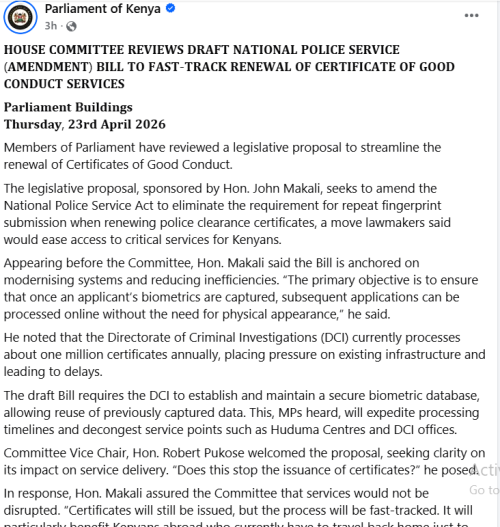
By Faith Lagat, April 23, 2026Parliament’s relevant House Committee has scrutinised the National Police Service (Amendment) Bill, 2026, a legislative proposal aimed at changing the renewal process of Certificates of Good Conduct by removing the requirement for repeated fingerprint submissions.
Sponsored by John Makali, the Bill seeks to amend the National Police Service Act to allow the Directorate of Criminal Investigations (DCI) to reuse previously captured biometric data for subsequent applications.
The proposal is intended to reduce processing time, lower costs for applicants, and ease congestion at police clearance service points.
Appearing before the Committee, on April 23, 2026, Makali said the reforms are intended to modernise public service delivery.
“The primary objective is to ensure that once an applicant’s biometrics are captured, subsequent applications can be processed online without the need for physical appearance,” he said.
He noted that the DCI processes about one million certificates annually, placing pressure on existing systems.
Digital database and system upgrade outlined
The draft law requires the DCI to establish and maintain a secure biometric database to allow reuse of captured data while complying with data protection requirements.
The system is expected to reduce queues at Huduma Centres and DCI offices and speed up processing for applicants locally and abroad.
Committee Vice Chair Robert Pukose asked: “Does this stop the issuance of certificates?” Makali responded that issuance would continue, adding that the process would be fast-tracked.
“It will particularly benefit Kenyans abroad who currently have to travel back home just to submit fingerprints and our youth having to physically visit centers to renew certificates of good conduct,” he said.
Members including Florence Jematia described the proposal as one that would improve efficiency and reduce costs associated with travel and repeated applications.
Funding gaps and implementation considerations
The Committee also reviewed financial implications linked to the ongoing upgrade of the Automated Palm and Fingerprint Identification System (APFIS) to the Multi-Biometric Identification System (MBIS).
The project is estimated at Ksh2.71 billion over five years, with Ksh1.138 billion already allocated and a funding gap of about Ksh1.57 billion. Completion is targeted for the 2028/29 financial year.
Christopher Aseka sought clarification on system readiness, with Makali stating that the Bill provides legal backing for secure storage and reuse of biometric data during the transition.
The Committee will consider the proposal alongside financial and policy implications before presenting its report to the House.