MPs probe KRA over controversial raw sugar import
By Faith Lagat, July 16, 2026The National Assembly’s Departmental Committee on Trade, Industry and Cooperatives has launched a probe into the Kenya Revenue Authority (KRA) over the clearance of a consignment of imported raw sugar by Mombasa Sugar Refinery Limited.
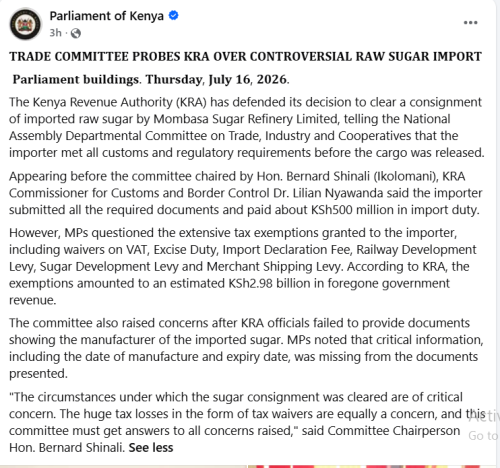
Appearing before the committee chaired by Ikolomani MP Bernard Shinali on Thursday, July 16, 2026, KRA Commissioner for Customs and Border Control Lilian Nyawanda defended the decision, saying the importer complied with all customs and regulatory requirements before the cargo was released.
According to Nyawanda, the importer submitted all the required documentation and paid approximately KSh500 million in import duty before the consignment was cleared.
The committee, however, questioned the extensive tax exemptions granted to the importer. KRA told MPs the consignment benefited from waivers on Value Added Tax (VAT), Excise Duty, Import Declaration Fee, Railway Development Levy, Sugar Development Levy and Merchant Shipping Levy.
According to the authority, the exemptions translated into an estimated Ksh2.98 billion in foregone government revenue.
Tax waivers raise concern
MPs also questioned the documentation accompanying the sugar consignment after KRA officials failed to provide records identifying the manufacturer of the imported sugar.
Committee members noted that key information, including the date of manufacture and expiry date, was missing from the documents presented to Parliament.
“The circumstances under which the sugar consignment was cleared are of critical concern. The huge tax losses in the form of tax waivers are equally a concern, and this committee must get answers to all concerns raised,” said Committee Chairperson Bernard Shinali.
The committee is now seeking further documentation on the consignment, including its country of origin, quality certification and intended end use.
The parliamentary scrutiny comes amid renewed debate over imported sugar and its impact on local farmers and government revenue.
Questions over imported sugar
He said imported sugar from Mauritius and Brazil was entering the country through the Port of Mombasa before being transported for local processing.
“Lakini hata kama imeoza, inatolewa pale inaletwa kwa kiwanda cha hapa Kisumu,” Muturi said.
He warned that continued importation was hurting cane farmers in Western Kenya and Nyanza, many of whom continue to face delayed payments, low prices and shrinking markets.
His remarks came after a recent media investigation examined Kenya’s sugar supply chain and the importation of industrial-grade raw sugar.
The report stated that large quantities of industrial-grade raw sugar are imported through Mombasa under classifications attracting lower taxes than refined sugar intended for direct household consumption.
According to the report, the sugar is later processed locally before being repackaged and distributed into the consumer market.
Probe expected to continue
Industry sources quoted in the investigation said industrial-grade sugar enters the country at lower tax rates before being processed, packaged and sold for household use.
The report also raised concerns over food safety, noting that industrial-grade sugar may contain impurities and residues not intended for direct human consumption.
Stakeholders within the sugar sector say inconsistent policy implementation and weak enforcement have allowed imported sugar to enter the market during local harvesting seasons, affecting domestic producers.
Customs authorities have indicated they are reviewing consignments flagged for possible misclassification and tax discrepancies, while some officials have cited institutional challenges and incomplete boards as factors affecting oversight.
The Trade Committee has directed KRA to provide additional documentation on the Mombasa Sugar Refinery consignment as the probe continues.
The inquiry is expected to examine the import approval process, tax waiver regime, customs classification and compliance with regulations governing industrial and consumer sugar imports.