Advertisement
MPs pass bill set to protect patients and introduce major healthcare reforms
Tuesday 02nd June, 2026 07:53 PM|

The National Assembly on Tuesday June 2, 2026, passed the Quality Healthcare and Patient Safety Bill, 2025, with amendments, paving the way for significant reforms in the regulation, standards and accountability of Kenya’s healthcare sector.
The proposed law seeks to establish a comprehensive framework for promoting quality healthcare services and strengthening patient safety across public, private and faith-based health facilities. It is designed to operationalise Article 43(1)(a) of the Constitution, which guarantees every person the right to the highest attainable standard of health.
Lawmakers said the Bill responds to longstanding challenges in the health sector, including cases of medical negligence, inconsistent standards of care, fragmented regulation and inadequate protection of patients’ rights. The legislation also aims to align Kenya’s healthcare system with internationally recognised quality and safety standards.
“The National Assembly has passed the Quality Healthcare and Patient Safety Bill, 2025, with amendments paving the way for a comprehensive overhaul of standards, regulation and accountability within Kenya’s health sector, the post read in part.
Patient rights and safety measures
You Might Also Like



A key component of the Bill is the formal recognition and protection of patient rights. The proposed law outlines several rights, including access to safe and quality healthcare services, treatment by qualified healthcare professionals, informed consent, access to information, dignity, equity and participation in healthcare decision-making.
Health facilities will be required to display a Patient Rights Charter and implement systems that support patient safety, including risk management programmes, quality improvement initiatives and adherence to evidence-based medical practices.
The Bill further requires healthcare institutions to ensure that medicines, medical devices and other health products used in patient care meet approved safety and quality standards.
In addition to outlining patient rights, the legislation also places responsibilities on patients to cooperate with healthcare providers and provide accurate information necessary for treatment and care.
New authority to oversee healthcare standards
The Bill proposes the establishment of the Quality Healthcare and Patient Safety Authority, which will serve as the main regulatory body responsible for maintaining standards across the sector.
The authority will be managed by a board comprising representatives from the national government, county governments, healthcare providers and patients’ associations. Its responsibilities will include registration, licensing, accreditation, inspections and enforcement of healthcare standards.
The regulator will also maintain a public register of health facilities and publish quality ratings to enhance transparency and accountability.

Under the proposed framework, all health facilities, including ambulances and medical camps, will be required to obtain registration, annual licences and accreditation. Compliance will be assessed based on factors such as infrastructure, staffing levels, clinical standards and patient outcomes.
Facilities found to be operating outside the law could face penalties, including suspension or revocation of licences, fines or closure.
Implementation and oversight framework
The Bill introduces mechanisms for regular inspections and monitoring of health facilities through appointed inspectors who will conduct both routine and unannounced visits.
A Health Care Tribunal will also be established to hear disputes arising from regulatory decisions and healthcare service delivery matters.
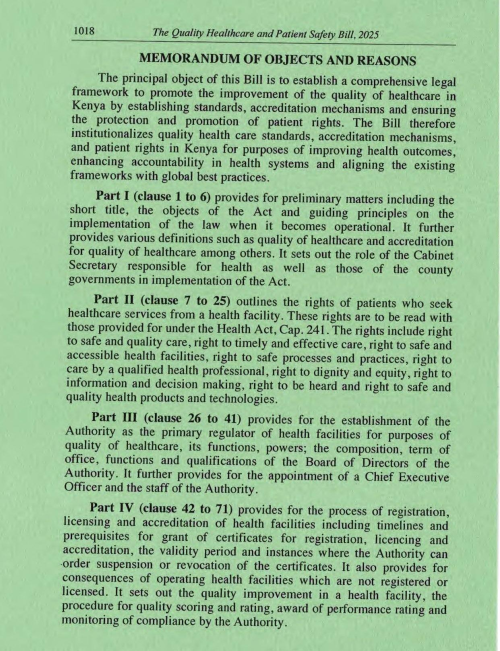
The legislation clearly outlines the roles of both levels of government. The Cabinet Secretary responsible for health will oversee the development of national standards and policies, while county governments will be responsible for implementation, monitoring and reporting through integrated digital health systems.
Existing health facilities will be given a six-month transition period to comply with the new requirements once the law comes into force.
The Bill also proposes amendments to several existing laws, including the Health Act and the Social Health Insurance Act, to ensure consistency within the healthcare regulatory framework.
Having been approved by the National Assembly, the Bill now proceeds to the Senate for consideration before being forwarded to the President for assent.
Author
Latest News








Advertisement
More on News