Advertisement
Moses Kuria explains why smaller counties may play decisive role in 2027 elections
Monday 04th May, 2026 11:25 AM|

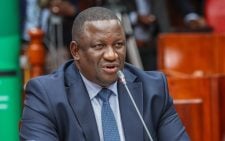
Former Cabinet Minister Moses Kuria has drawn fresh attention after a detailed late-night interview on Sunday, May 4, 2026, in which he broke down voter registration patterns across Kenya, dividing the country into what he called ‘small numbers’, ‘large counties’, and ‘swing counties’.
Speaking in a long, data-heavy analysis, Kuria said the latest voter registration exercise showed uneven performance across regions, but insisted that every bloc carried political weight ahead of future elections.
He framed his argument around efficiency and turnout, saying:
“In terms of voter registration… 26 counties of what I’m calling tyranny of small numbers achieved 99.98 per cent. Close to 100 per cent overall.”
You Might Also Like



“So counties which underperformed like in the Luo Nyanza were compensated by counties like Turkana, etc, etc”
According to Kuria, these 26 counties performed almost at full capacity against the Independent Electoral and Boundaries Commission (IEBC) targets. He argued that smaller, less populated counties required more effort to mobilise voters, describing the process as demanding and labour-intensive.
“These counties… you have to walk a very long distance to put them together. It’s like what I call hunters and gatherers.”
He added that the 26 counties collectively registered about 971,719 new voters, saying this group may appear small individually but collectively carried significant influence.
Comparison with larger counties
Kuria contrasted this with what he described as 14 larger counties, which he associated with opposition-leaning areas. These counties include Meru, Tharaka Nithi, Embu, Kitui, Machakos, Makueni, Nyandarua, Nyeri, Kirinyaga, Murang’a, Kiambu, Laikipia, Kisii, and Nyamira.
He said these counties, despite having a simpler mobilisation structure due to population size, performed below expectations.
“So the ‘tyranny of small numbers’ is mostly within the broad-based government, while the ‘tyranny of numbers’ is mostly within the opposition.”
“These counties achieved 84 per cent of target of what IEBC had given them… less than what the tyranny of small numbers achieved.”
He claimed the larger counties registered about 7.7 million voters in 2022, but in the latest exercise, they lagged behind in percentage performance.

He further argued that the smaller counties outperformed them by about 270,000 additional voters in the latest cycle.
“The difference… is 270,000. That is enough to tilt an election.”
Kuria did not present this as a prediction, but as a warning about how voter mobilisation gaps could influence tight national contests.
Swing counties become key focus
A large part of his argument focused on seven counties he described as “swing votes,” saying these regions could determine election outcomes.
“Let us move on to the other group. We have seven counties we have not counted for now. These are the seven counties which I call the swing votes, and every country has its swing vote. Yes, in America we have Ohio, Iowa, Pennsylvania, you know.”
He listed them as Trans Nzoia, Nakuru, Kajiado, Kakamega, Vihiga, Bungoma and Nairobi.
“These counties… nobody can say clearly this is opposition or government. Everybody has got a fighting chance.”
Kuria said these swing counties registered about 668,000 new voters in the latest exercise. He noted that this translates to roughly nearly 100,000 new voters per county on average, though he acknowledged that larger counties like Nairobi skew the average.
He also compared registration progress against IEBC targets, citing variations in performance.
For example, he said:
- Trans Nzoia acheived 93 per cent.
- Nakuru achieved around 89 per cent.
- Kajiado reached about 104 per cent.
- Kakamega recorded about 98 per cent.
- Vihiga performed poorly at around 69 per cent.
- Bungoma and Nairobi performed strongly, with Nairobi reportedly exceeding 100 per cent.
“Nairobi achieved 101 per cent,” he said, pointing to what he described as strong urban mobilisation.
Interpretation of political impact
Kuria repeatedly tied voter registration performance to electoral outcomes, arguing that mobilisation effort matters more than geography or size.
“In terms of performance, the tyranny of small numbers achieved almost 100 per cent… compared with 85 per cent for the large counties.”
He said the cumulative effect of small differences in registration numbers could shape close elections.
“If you look at it from the performance of this voter registration, this is where elections will be lost and won.”
He added that the swing counties, despite being fewer in number, would ultimately decide national direction due to their unpredictable voting patterns.
Author
Kenneth Mwenda
Kenneth Mwenda is a business, sports, and politics digital writer with over seven years of experience in journalism, covering breaking news, feature stories, and in-depth analysis across a range of beats.
For inquiries, he can be reached at [email protected]
View all posts by Kenneth MwendaLatest News






Advertisement
More on News