Morara Kebaso: Tribalism fuels election of corrupt leaders
By Nancy Marende, September 16, 2025Political activist Morara Kebaso has criticised tribal politics, arguing that it continues to undermine Kenya’s democracy and economic progress.
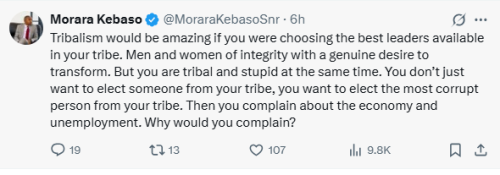
In a statement on Monday, September 15, 2025, Kebaso noted that while tribal loyalty could be positive if it meant supporting leaders of integrity, competence, and vision within one’s community, the reality has been the opposite.
“Tribalism would be amazing if you were choosing the best leaders available in your tribe—men and women of integrity with a genuine desire to transform. But you are tribal and stupid at the same time. You don’t just want to elect someone from your tribe; you want to elect the most corrupt person from your tribe. Then you complain about the economy and unemployment. Why would you complain?” Kebaso remarked.
Matiang’i on tribalism
His remarks come months after the former Interior Cabinet Secretary (CS) Fred Matiang’i questioned why tribalism remains central to Kenya’s politics instead of competence and integrity.
Speaking at a town hall meeting with Kenyans living in Texas on June 16, 2025, the former CS urged Kenyans to reject tribalism and demand accountability and capability from those seeking leadership.
“Why are we actually having a debate about tribes in our country? When we go to a hospital, I am not aware of anyone who goes around and looks at the board and says, this is a doctor from my tribe so that I can be treated.’ You go in and you get a service. The government should be about service, not ethnic alliances,” Matiang’i said.
He challenged Kenyans in the diaspora to play a more active role in sensitising citizens back home to reject tribalism and embrace merit-based leadership.
“I ask you, more than anyone else, you who live in the US and are exposed to a different environment, the most important thing you can do to help our people is to push this message. Persuade our people to understand that where we’re going is not about ethnic communities. It’s about a simple question: Can you or can you not do the job?” he posed.