Advertisement
Ministry of Health issues advisory to Kenyans after Ebola outbreak in DRC
Saturday 16th May, 2026 04:03 PM|
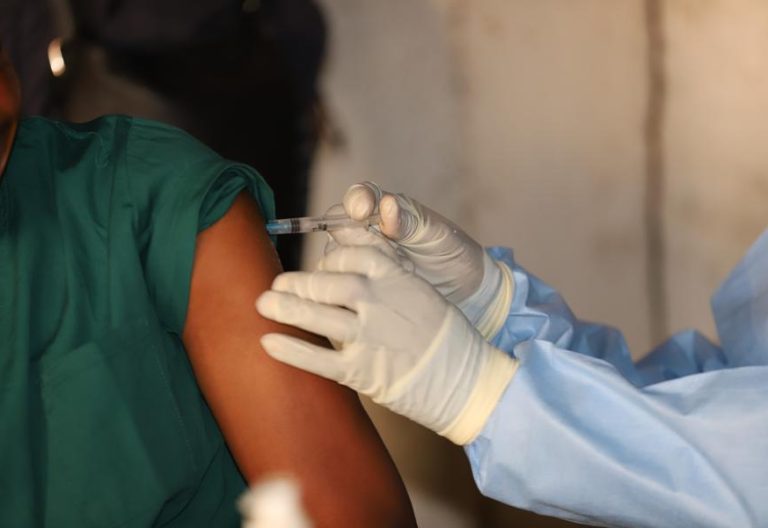
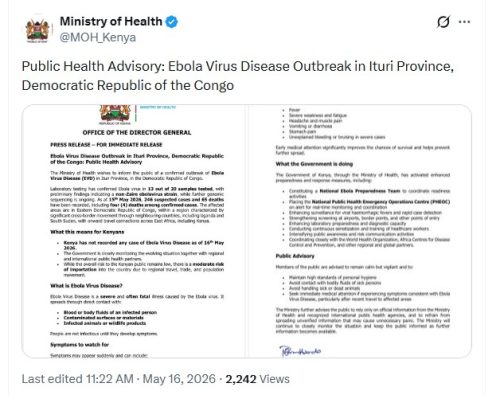
The Ministry of Health has issued a public advisory on Ebola virus disease following an outbreak in Ituri Province, Democratic Republic of the Congo.
In a statement on Saturday, May 16, 2026, the MoH confirmed that the government has activated enhanced preparedness and response measures to curb the deadly virus.
“The Ministry of Health wishes to inform the public of a confirmed outbreak of Ebola Virus Disease (EVD) in Ituri Province, in the Democratic Republic of Congo,” the MoH stated.
The reports come after laboratory testing has confirmed Ebola virus in 13 of 20 samples, with preliminary findings indicating a non-Zaire ebolavirus strain, while further genomic sequencing is ongoing.
You Might Also Like
As of May 15, 2026, 246 suspected cases and 65 deaths have been recorded, including four (4) deaths among confirmed cases.
Worth noting, the affected areas are in the Eastern Democratic Republic of Congo, within a region characterised by significant cross-border movement through neighbouring countries, including Uganda and South Sudan, with onward travel connections across East Africa, including Kenya.
What this means for Kenyans
Meanwhile, the Ministry of Health has announced that Kenya has not recorded any case of Ebola Virus Disease as of May 16, 2026.
Further adding that the government is closely monitoring the evolving situation together with regional and international public health partners.
“The Government is closely monitoring the evolving situation together with regional and international public health partners,” MoH said.
While the overall risk to the Kenyan public remains low, the Ministry of Health has said that there is a moderate risk of importation into the country due to regional travel, trade, and population movement.
What is Ebola Virus Disease?
Ebola Virus Disease is a severe and often fatal illness caused by the Ebola virus.
According to the Ministry, Ebola spreads through direct contact with: Blood or body fluids of an infected person, Contaminated surfaces or materials and Infected animals or wildlife products
In addition, MoH has explained that people are not infectious until they develop symptoms.
And that the Symptoms to watch for can include fever, severe weakness and fatigue, Headache and muscle pain, Vomiting or diarrhoea and Stomach pain.
At the same time, some of the symptoms include unexplained bleeding or bruising in severe cases.
MoH has further noted that early medical attention significantly improves the chances of survival and helps prevent further spread.
What the Government is doing
The Government of Kenya, through the Ministry of Health, has activated enhanced preparedness and response measures, including: Constituting a National Ebola Preparedness Team to coordinate readiness activities
Placing the National Public Health Emergency Operations Centre (PHEOC) on alert for real-time monitoring and coordination, enhancing surveillance for viral haemorrhagic fevers and rapid case detection
Strengthening screening at airports, border points, and other points of entry, enhancing laboratory preparedness and diagnostic capacity
Conducting continuous sensitisation and training of healthcare workers, Intensifying public awareness and risk communication activities
Coordinating closely with the World Health Organization, Africa Centres for Disease Control and Prevention, and other regional and global partners.
Public Advisory
Members of the public are advised to remain calm but vigilant and to maintain high standards of personal hygiene
To avoid contact with bodily fluids of sick persons, avoid handling sick or dead animals
Also, seek immediate medical attention if experiencing symptoms consistent with Ebola Virus Disease, particularly after recent travel to affected areas
The Ministry further advises the public to rely only on official information from the Ministry of Health and recognized international public health agencies, and to refrain from spreading unverified information that may cause unnecessary panic.
The Ministry has further announced that it will continue to closely monitor the situation and keep the public informed as further information becomes available.
Author
Latest News






Advertisement
More on News