Matatu stakeholders raise concerns after NTSA’s instant fines rollout
By Aloys Michael, March 10, 2026The Federation of Public Transport Sector (FPTS) has reacted to the introduction of the Instant Fines System Technology by the National Transport and Safety Authority (NTSA), raising several concerns over gaps in its implementation.
While acknowledging the potential benefits of the new system, matatu stakeholders say aspects of the rollout require urgent clarification to avoid confusion within the public transport sector.
However, the federation urged NTSA to clarify enforcement guidelines, particularly on how responsibility will be shared among vehicle owners, drivers, and SACCO management across the country.
“The use of technology will help improve driver discipline and reduce corruption, which can lead to fewer road accidents in Kenya,” the statement read in part.
The federation noted that many drivers still lack clear information on offences captured by the cameras and the penalties attached, as they called for the publishing of a transparent list, which could help motorists understand rules before fines accumulate across the country.
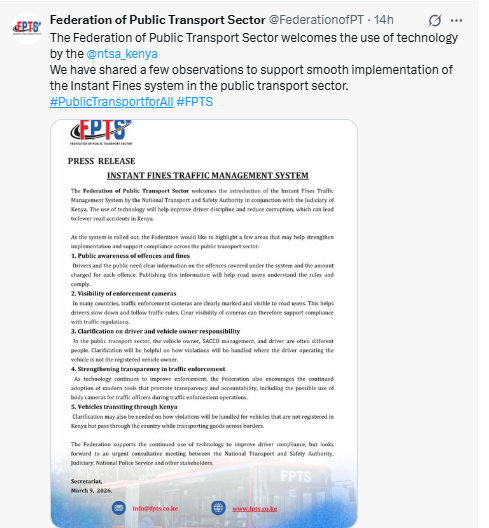
“Drivers and the public need clear information on the offences covered under the system and the amount charged for each offence. Publishing this information will help road users understand the rules and comply,” FTPS said.
The federation also wants enforcement cameras visibly marked along highways and urban roads, saying international experience shows drivers slow down when they know surveillance exists, effectively helping to curb violations.
“In many countries, traffic enforcement cameras are clearly marked and visible to road users. This helps drivers slow down and follow traffic rules. Clear visibility of cameras can therefore support compliance with traffic regulations,” the statement read.
Another key concern raised by operators is the issue of accountability when a traffic violation occurs. The Federation noted that in many cases, a PSV may be driven by different individuals, while the registered owner or SACCO management may not be the person operating the vehicle at the time of the offence.
This, they said, has created uncertainty over who ultimately bears responsibility for fines issued digitally under the new system.

Fines and penalties
The question of cross-border transport has also emerged as a concern, as trucks from neighbouring countries frequently pass through Kenya. Transport operators are seeking clarity from authorities on how drivers of foreign-registered vehicles will receive violation alerts, settle fines, and clear penalties before leaving the country.
According to the NTSA, the digital enforcement system is supported by more than 1,000 smart cameras capable of detecting at least 37 traffic offences in real time. These include speeding, lane indiscipline, driving on pavements, and failure to wear seatbelts on roads across Kenya.
Fines issued through the system range from Ksh500 to Ksh10,000 depending on the offence. Motorists who fail to settle penalties within seven days risk incurring additional interest charges and losing access to NTSA service platforms.
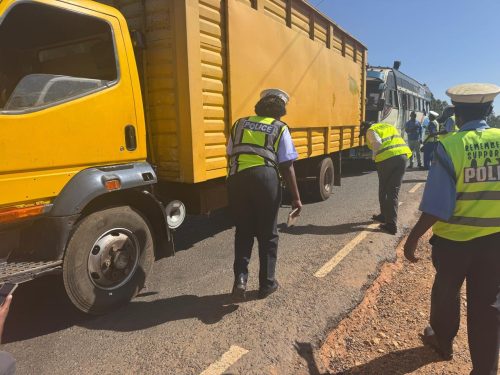
Authorities say drivers who ignore the penalties will also be restricted from carrying out transactions on NTSA platforms until the fines are paid, a measure intended to improve compliance as the country moves toward automated traffic enforcement.
However, transport operators caution that the system is being introduced at a time when road safety enforcement agencies are grappling with ongoing budget constraints. They warn that without consistent government funding, maintaining camera networks, data systems, and monitoring infrastructure could become difficult.
Industry players also highlight an existing backlog of traffic cases in court, noting that disputes arising from automated tickets could further strain the Judiciary if motorists decide to challenge the penalties in courts across the country.
The federation maintains that a consultative meeting involving the NTSA, the Judiciary, and the National Police Service (NPS) is essential to harmonise enforcement procedures before the instant fines system significantly changes driving practices nationwide.