Maraga warns new privatisation law hands Treasury unchecked powers over public assets
By Kenneth Mwenda, October 21, 2025Former Chief Justice David Maraga has criticised the government’s new Privatisation Act, warning that it gives the Treasury sweeping powers to sell public assets without sufficient parliamentary oversight.
Speaking during a press conference on Tuesday, October 21, 2025, Maraga said the law risks placing key state assets in foreign hands and undermining public accountability.
“Fellow Kenyans, on several occasions I have stressed that in its elaborate corruption scheme this government is out to outrightly re-rope Kenyans,” Maraga said.
Watch: Maraga warns new privatisation law hands Treasury unchecked powers over public assets
“This is exactly what the repeal of the Privatisation Act 2005 and the enactment of the new Privatisation Act are doing.”
The former CJ said the law hands the entire privatisation process to the Executive through the Treasury Cabinet Secretary and the Privatisation Authority.
“It grants the CS Treasury power to create a privatisation programme which may include an unlimited number of public entities earmarked for privatisation,” he said.
Sections 22 and 23 of the Act allow the Cabinet Secretary to table the privatisation programme before the National Assembly for ratification within 60 days. If the Assembly fails to act within that period, the process automatically proceeds within 30 days without parliamentary approval.
“Once approved, the programme is valid for eight years,” Maraga said, repeating the point to underline the long-term implications. “The most outrageous part of this process is that the ratification request is only to be accompanied by brief descriptions of the entities undergoing privatisation, brief reasons for privatisation, and expected benefits including expected revenue.”
He added that the Act does not require the Treasury to include valuations of the entities in the ratification request.
“This is meant to entirely circumvent the necessary elaborate parliamentary oversight and neuter public participation,” Maraga said.
He also raised concern that the law lacks mechanisms for parliamentary monitoring once a privatisation programme is approved.
“In fact, the Act even exempts publication of the names of the buyers if the privatisation is by an initial public offering (IPO). Simply put, if they sell to themselves or their proxies, the Kenyan people will not get to know. If they sell even strategic assets to foreigners and put them beyond the country’s control, the Kenyan people will not get to know,” he said.
Maraga’s remarks came days after Parliament passed the Privatisation Bill (National Assembly Bill No. 36 of 2025) on October 9. President William Ruto later signed it into law on October 15, alongside seven other controversial Bills, including amendments to the Land and Cybercrimes Acts.
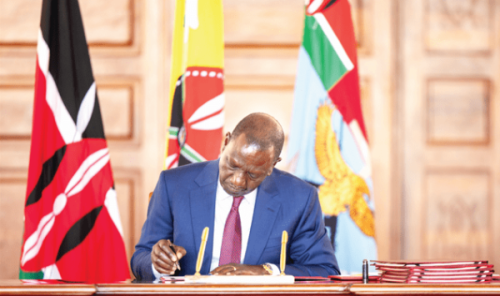
The National Assembly said the new law would streamline the sale of state enterprises and improve efficiency, transparency and economic competitiveness. However, several leaders and civil society groups have rejected that explanation, saying the law opens the door to abuse.
Critics warn of asset plunder
Among the state corporations already lined up for sale are the Kenyatta International Convention Centre (KICC), Kenya Pipeline Company (KPC), New Kenya Cooperative Creameries (KCC), Kenya Seed Company, National Oil Corporation of Kenya, Kenya Literature Bureau, Western Kenya Rice Mills, Numerical Machining Complex, Vehicle Manufacturers Limited, Rivatex East Africa, and Mwea Rice Mills.
Former Attorney General Justin Muturi has also condemned the move, warning that the government is disguising land grabs as reform. In a statement titled The Great Plunder Disguised as Reform, Muturi said dissolving the Kenya Petroleum Refineries Limited (KPRL) and transferring its assets to the Kenya Pipeline Company is a calculated move to take control of prime coastal land.
“KPRL owns more than 400 acres of land in Nyali and Kilifi, parts of which face the Indian Ocean,” Muturi said. “Once the land is moved under KPC, and KPC is later privatised, the property will end up in private hands.”
He argued that the government’s privatisation drive is not about efficiency but about liquidating public wealth.
Consumer groups such as Cofek have already obtained court orders stopping the KPC sale until public participation concerns are addressed. But the Treasury maintains that privatisation will raise funds for the national budget and give Kenyans a chance to buy shares in top state firms.