Maraga: Excessive govt borrowing has drained liquidity from local market
By Ndiritu Wanjiru, June 18, 2026Retired Chief Justice and 2027 presidential hopeful David Maraga has criticised the government’s borrowing practices, arguing that excessive debt accumulation has negatively affected businesses by reducing liquidity in the local market.
Speaking in an interview with a local TV station on Wednesday, June 18, 2026, Maraga said that heavy government borrowing has made it increasingly difficult for small businesses and small and medium enterprises (SMEs) to access affordable credit from commercial banks.
“What has this excessive borrowing done? First of all, it has brought liquidity from the local market. Small businesses and SMEs cannot get money from the banks. The banks are prone to lending to the government because they are not going to have any challenges recovering it, and because of that, the interest rates are very high. So, for a small business to go and borrow, it becomes extremely difficult, and with that, activities are suppressed,” Maraga said.

According to the former chief justice, banks prefer lending to the government because such loans carry lower risks compared to lending to private businesses. As a result, a significant portion of available capital is directed toward financing government operations, leaving entrepreneurs and investors struggling to obtain financing for expansion and growth.
Maraga argued that the situation has contributed to the suppression of economic activity, particularly among SMEs, which are widely regarded as the backbone of Kenya’s economy and a major source of employment.
Maraga’s plan to audit odious debt
The presidential hopeful also outlined his plans for addressing the country’s debt burden should he win the 2027 general election.
Maraga pledged to conduct a comprehensive audit of what he described as “odious debt”, saying his administration would review all questionable loans and determine whether they complied with constitutional requirements.
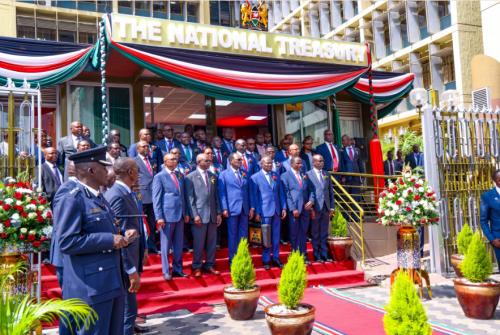
John Mbadi, accompanied by principal secretaries Mr Cyrell Wagunda (Public Investments and Assets Management) Dr Chris Kiptoo
(PS National Treasury) and Dr Bonface Makokha
(Economic Planning) alongside other senior officials from the Ministry before the presentation of the Financial Year 2026/2027 Ksh 4.8 trillion budget at the National Assembly. PHOTO/@SDPI_AM/X.
“We will audit the odious debt and take appropriate action against that. There are some we will refuse to pay, because the Constitution requires money to be borrowed for projects,” he said.
He maintained that public borrowing must be tied to legitimate development projects that benefit citizens and comply with constitutional provisions.
Maraga said an audit would help establish accountability in the management of public debt while ensuring taxpayers are not burdened with obligations arising from irregular or unjustified borrowing.
Kenya’s debt
Kenya’s total public and publicly guaranteed debt stands at an estimated Ksh13 trillion. This translates to a debt-to-GDP ratio of approximately 68% to 71%, driven by sustained domestic borrowing and persistent fiscal deficits. Debt servicing consumes more than 60% of ordinary revenue collections.