LSK President Faith Odhiambo urges lawyers to take bold action in safeguarding justice
By Faith Lagat, August 16, 2025The Law Society of Kenya (LSK) has called on legal professionals to take an active role in safeguarding constitutionalism and accountability, emphasising that justice cannot thrive in silence.
The call came during the 2025 LSK Annual Conference in Diani, which concluded on August 16, 2025.
Speaking on the final day, LSK President Faith Odhiambo stressed the importance of vision and principle in the profession.
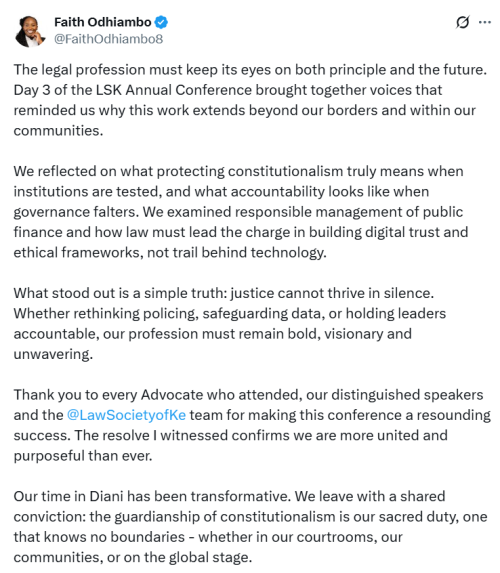
“The legal profession must keep its eyes on both principle and the future. Day 3 of the LSK Annual Conference brought together voices that reminded us why this work extends beyond our borders and within our communities,” she said.
The discussions explored critical issues, including ethical management of public finances, digital governance frameworks, and reforming policing practices—topics that resonate with Kenya’s ongoing quest for a just society.
Lawyers in ensuring accountability
Odhiambo’s address highlighted a defining moment for Kenya’s legal fraternity, which represents over 20,000 advocates committed to upholding the rule of law. “We reflected on what protecting constitutionalism truly means when institutions are tested and what accountability looks like when governance falters,” she said.
The conference theme, “Protecting Constitutionalism and the Rule of Law—Ensuring Accountability”, has gained urgency after Kenya was placed on the Financial Action Task Force (FATF) “Grey List” in 2024 over weaknesses in anti-money laundering controls.
Director of Public Prosecutions Renson Ingonga also addressed delegates, urging deeper collaboration between the DPP’s office and the LSK to fight graft. He cited recent convictions of former governors as evidence of progress and recommended plea bargaining to reduce case backlogs, calling it “not a surrender—it is survival.” Similar approaches in other jurisdictions have reduced backlogs by up to 30 per cent.
Future of legal practice
The conference also featured the launch of a report by a consortium reviewing legal frameworks for advocates. Odhiambo invited feedback from members by August 25, emphasising that reform must be participatory. “If we want to build a legal system that works for both the advocate and the public, then we must build it together. Policy crafted in silence never serves justice,” she said.
Odhiambo concluded with a call for unity and vigilance: “Our time in Diani has been transformative. We leave with a shared conviction: the guardianship of constitutionalism is our sacred duty, one that knows no boundaries—whether in our courtrooms, our communities, or on the global stage.” Her remarks signal a united front among lawyers to ensure that justice prevails through active engagement and unwavering commitment.