Ledama urges urgent action on flood preparedness amid El Niño warning
By Mustafa Juma, May 30, 2026Narok Senator Ledama Olekina has called on Kenyans to urgently shift focus from political competition to national preparedness, warning that the country is heading into a potentially dangerous weather season driven by a developing Super El Niño system.
Taking to his official X account on Saturday, May 30, 2026, Olekina cautioned that several regions, including Nairobi, Kisumu, Mombasa, Tana River, Athi River, Narok, Maasai Mara, Western Kenya, and other landslide-prone areas, are at high risk of flooding and environmental disaster if mitigation measures are not taken immediately.
The senator warned that while political attention is currently focused on the 2027 general election, the country risks being caught unprepared for severe climatic events that could cause widespread destruction.
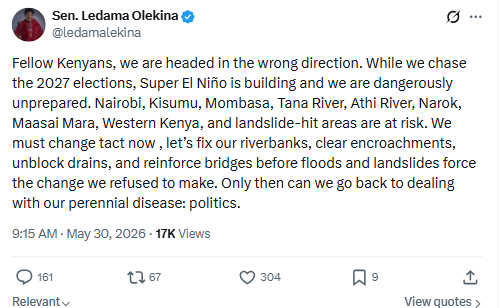
“Fellow Kenyans, we are headed in the wrong direction. While we chase the 2027 elections, Super El Niño is building, and we are dangerously unprepared,” Olekina said.
He urged both national and county governments to prioritise disaster preparedness over political activity, arguing that climate risks pose an immediate and non-partisan threat.
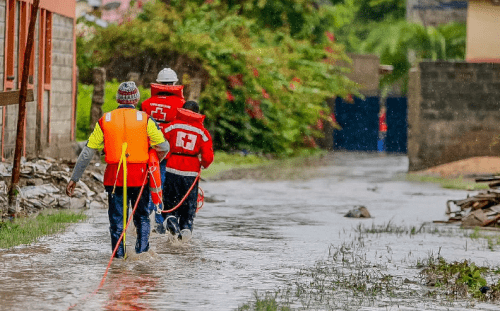
High-risk regions
Olekina highlighted several regions he said are particularly vulnerable, citing low-lying urban centres and flood-prone river basins as areas of concern.
He specifically mentioned Nairobi, Kisumu, and Mombasa, alongside counties such as Tana River, Narok, and parts of Western Kenya.
He further warned that poor drainage systems, encroached riverbanks, and blocked waterways could worsen the impact of heavy rainfall.
“Nairobi, Kisumu, Mombasa, Tana River, Athi River, Narok, Maasai Mara, Western Kenya, and landslide-hit areas are at risk,” he stated.
Call for immediate mitigation measures
The senator called for urgent interventions, including clearing drainage systems, restoring natural waterways, reinforcing bridges, and removing encroachments along riverbanks.
“We must change tact now. Let’s fix our riverbanks, clear encroachments, unblock drains, and reinforce bridges before floods and landslides force the change we refused to make,” he said.
Olekina stressed that preventive action is more effective and less costly than emergency response, warning that failure to act could lead to avoidable loss of life and property.
World Met warning
The World Meteorological Organization (WMO) had issued a high-confidence alert that an El Niño event is likely to emerge between May and July 2026, with models suggesting it could develop into a strong episode lasting nine to twelve months.
The Global Seasonal Climate Update, dated Friday, April 24, 2026, indicates a rapid rise in equatorial Pacific sea-surface temperatures following a period of neutral ENSO conditions after the 2025–26 La Niña.
“Climate models are now strongly aligned, and there is high confidence in the onset of El Niño, followed by further intensification,” Wilfran Moufouma Okia, Chief of Climate Prediction at WMO, said.
He noted that while the spring predictability barrier poses some uncertainty, forecast confidence typically improves after April 2026.
El Niño, the warm phase of the El Niño–Southern Oscillation (ENSO), is characterised by warming of ocean surface temperatures in the central and eastern equatorial Pacific.
It typically occurs every two to seven years and lasts about nine to twelve months.