Ledama Olekina urges bold agricultural reforms to secure Kenya’s future
By Faith Lagat, October 11, 2025Narok Senator Ledama Olekina has intensified his push for transformative reforms in Kenya’s agricultural sector, positioning agriculture as central to the country’s long-term food security and economic growth.
In a series of statements posted on X on October 11, 2025, the senator emphasized the need for strong policy frameworks, the development of local seed banks, and reduced reliance on the Organization for Economic Co-operation and Development (OECD) nations.
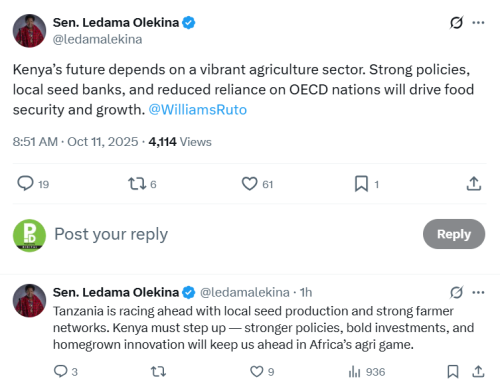
“Kenya’s future depends on a vibrant agriculture sector. Strong policies, local seed banks, and reduced reliance on OECD nations will drive food security and growth,” he stated.
Tanzania’s progress sets benchmark
Olekina highlighted Tanzania’s advancements in local seed production and farmer network development as a model Kenya could emulate. He urged for urgent investments and homegrown innovations to keep the country competitive within Africa’s agricultural landscape.
“Tanzania is racing ahead with local seed production and strong farmer networks. Kenya must step up, stronger policies, bold investments, and homegrown innovation will keep us ahead in Africa’s agri game,” he said in a follow-up post.
The senator’s advocacy comes amid growing debates on seed sovereignty, with increasing calls for Kenya to reduce external influence and strengthen its domestic agricultural systems.
Dispute with KEPHIS
Olekina’s remarks build on an ongoing dispute with the Kenya Plant Health Inspectorate Service (KEPHIS) over regulatory control of seed standards. On September 7, 2025, he advocated for the establishment of a Kenya Bureau of Standards (KEBS)-regulated seed standards law, arguing it would enhance local innovation and reduce foreign dependency.
“Let’s not let @KephisKe sabotage progress with negative spin; embracing a KEBS-regulated local seed standards law empowers homegrown innovation,” he wrote.
The row escalated after KEPHIS opposed the Seeds and Plant Varieties (Amendment) Bill, 2025. On September 6, Olekina accused the agency of sponsoring misleading narratives regarding the Bill.
“Recent articles sponsored by @KephisKe and subsequent editorial commentary have misrepresented both the intent and content of the Seeds and Plant Varieties (Amendment) Bill, 2025. It is important to set the record straight and ensure a fact-based discussion on this critical policy matter,” he posted.
KEPHIS has defended its position, with board chair Joseph M’eruaki warning that transferring seed certification functions to KEBS could lead to regulatory confusion.
“KEPHIS regulates the quality of seed and provides certification, but it is now proposed that this function be transferred to KEBS, which will cause confusion,” he said in July.