Advertisement
Ledama Olekina defends local seed standards, accuses KEPHIS of sabotage
Sunday 07th September, 2025 12:29 PM|

Narok Senator Ledama Olekina has taken issue with the Kenya Plant Health Inspectorate Service (KEPHIS), accusing the agency of undermining efforts to promote the adoption of homegrown seed standards.
In a statement released on Sunday, September 7, 2025, the senator, who has been a strong advocate for locally produced seeds, emphasised the need for Kenya to embrace seeds certified by the Kenya Bureau of Standards (KEBS).
He argued that the proposed KEBS-regulated seed standards law would empower local innovation and strengthen the country’s agricultural independence.
Olekina warned that blocking the implementation of such a framework would put Kenya at a disadvantage, leaving it dependent on external influence from permanent members of the Organisation for Economic Co-operation and Development (OECD).
You Might Also Like



According to him, such dependency would compromise the country’s ability to achieve seed sovereignty and long-term food security.
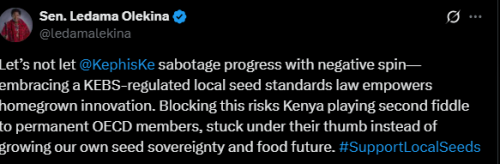
“Let’s not let @KephisKe sabotage progress with negative spin—embracing a KEBS-regulated local seed standards law empowers homegrown innovation. Blocking this risks Kenya playing second fiddle to permanent OECD members, stuck under their thumb instead of growing our own seed sovereignty and food future,” he said.
This comes amid a brewing row between Senator Ledama Olekina and the Kenya Plant Health Inspectorate Service (KEPHIS) over the Seeds and Plant Varieties (Amendment) Bill, 2025.
KEPHIS vs Ledama war
In a statement on X on Saturday, September 6, 2025, Senator Olekina accused KEPHIS of sponsoring misleading narratives about the Bill.
“Recent articles sponsored by @KephisKe and subsequent editorial commentary have misrepresented both the intent and content of the Seeds and Plant Varieties (Amendment) Bill, 2025. It is important to set the record straight and ensure a fact-based discussion on this critical policy matter,” he said.
Earlier, in July, KEPHIS had urged the Senate to reject the Bill, warning that it could severely weaken seed quality control and put food security at risk. Board chair Joseph M’eruaki argued that introducing a standards-based registration system under the Kenya Bureau of Standards (KEBS) would create a parallel regulatory framework and cause confusion.
“KEPHIS regulates the quality of seed and provides certification, but it is now proposed that this function be transferred to KEBS, which will cause confusion,” he said.
M’eruaki stressed that splitting the role between two ministries would fragment accountability and compromise oversight.
Author
Latest News








Advertisement
More on News