Ledama Olekina proposes giving EACC prosecutorial powers
By Kenneth Mwenda, September 11, 2025Senator Ledama Olekina has renewed the debate on whether the Ethics and Anti-Corruption Commission (EACC) should be granted prosecutorial powers.
Writing on his X account on Thursday, September 11, 2025, the Narok senator said that making the EACC a branch of the Office of the Director of Public Prosecutions (ODPP) would allow the Director of Public Prosecutions (DPP) to delegate prosecutorial powers to the commission.
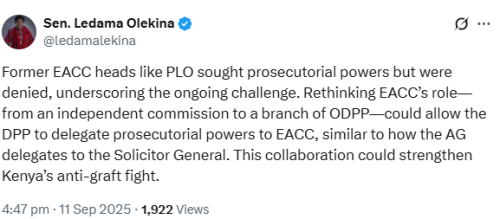
“Former EACC heads like PLO sought prosecutorial powers but were denied, underscoring the ongoing challenge.”
Rethinking EACC’s role—from an independent commission to a branch of ODPP—could allow the DPP to delegate prosecutorial powers to EACC, similar to how the AG delegates to the Solicitor General. This collaboration could strengthen Kenya’s anti-graft fight,” wrote Ledama.
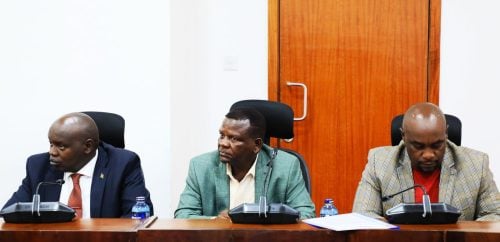
His remarks come after the Senate County Public Accounts Committee (CPAC) summoned DPP Renson Ingonga to explain the withdrawal of 18 graft-related cases involving county governments. The cases, touching on county executives and assemblies, were withdrawn despite billions of taxpayers’ money being at stake.
EACC’s Chief Executive Officer Abdi Mohamed told senators that most of the cases were dropped by the DPP without consultation. He said the EACC had no control over such decisions, as the constitution gives the DPP the power to withdraw cases.
“While we are not questioning the withdrawal of the cases, it is our humble plea that as investigators, they should be courteous and inform us when making the withdrawals,” Mohamed told the committee.
He further revealed that the commission handles up to 3,000 complaints daily but has only 200 investigators across the country.
Senators, led by Okongo Omogeni, questioned whether Kenya has a “general prosecutor problem” and pressed for reforms to ensure graft cases are not lost through withdrawals and weak coordination. EACC leadership urged the lawmakers to consider amending the law to allow them to prosecute their cases.
“There is a problem in the prosecution, and we need to admit it,” Omogeni said, adding that the solution does not lie in sweeping the problems under the carpet.
“There is a clear disconnect between the office of the DPP and the EACC,” he argued.
Support
The debate on EACC’s prosecutorial role is not new. Civil society groups such as Transparency International-Kenya and the Kenya Human Rights Commission have previously argued that granting EACC prosecutorial powers would reduce conflict between investigators and prosecutors.
In February 2024, the groups criticised the ODPP for withdrawing corruption cases involving politically connected individuals, saying it undermined the fight against graft.
The Justice and Legal Affairs Committee (JLAC) of the National Assembly had also backed the idea of the DPP gazetting EACC lawyers as special prosecutors. In December 2024, JLAC vice chairperson Mwengi Mutuse said such a move would end the current tussle between the two agencies.
EACC boss Abdi Mohamud, during his vetting last year, made a similar case. He argued that EACC lawyers, who are already involved in collecting and reviewing evidence, are better placed to prosecute corruption cases directly.