Advertisement
Lawyer Willis Otieno breaks down Kenya’s debt crisis
Sunday 05th April, 2026 02:54 AM|

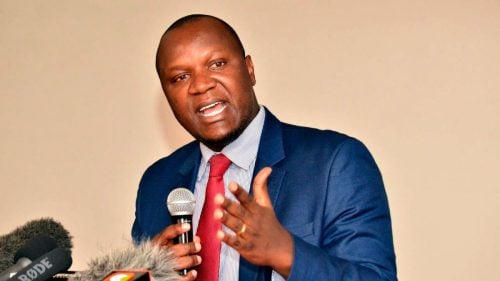
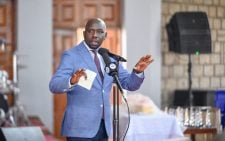
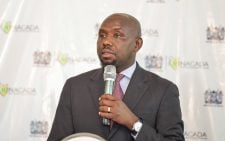
Lawyer Willis Otieno has issued a scathing assessment of Kenya’s growing public debt.
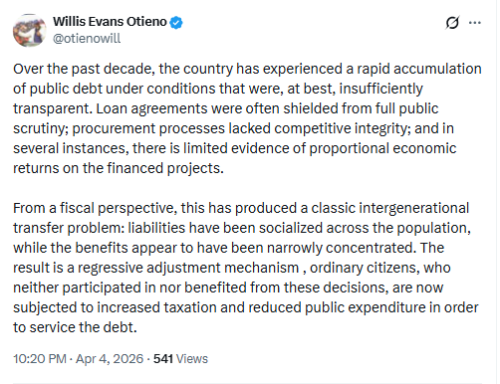
Taking to his official X account on the night of Saturday, April 4, 2026, the Safina Deputy Party Leader warned that years of opaque borrowing and weak oversight have left ordinary citizens bearing the burden of decisions they neither participated in nor benefited from.
He argued that the country’s debt trajectory over the past decade reflects systemic governance failures, particularly in transparency, procurement integrity, and accountability.
Opaque borrowing
According to Otieno, many loan agreements entered into during this period were not subjected to full public scrutiny, raising concerns about how decisions were made and whether due process was followed.
You Might Also Like


“Over the past decade, the country has experienced a rapid accumulation of public debt under conditions that were, at best, insufficiently transparent,” he said.
He further noted that procurement processes tied to these loans often lacked competitive integrity, while in several cases, there is little evidence to show that the projects financed delivered proportional economic returns.
Burden passed to citizens
Otieno described the current situation as a classic case of intergenerational inequality, where financial obligations are spread across the population while benefits remain concentrated among a few.
“Loan agreements were often shielded from full public scrutiny; procurement processes lacked competitive integrity; and in several instances, there is limited evidence of proportional economic returns on the financed projects,” he stated.
“From a fiscal perspective, this has produced a classic intergenerational transfer problem: liabilities have been socialized across the population, while the benefits appear to have been narrowly concentrated.”
The consequence, he explained, is a regressive economic adjustment, where ordinary Kenyans are now facing increased taxation and reduced public spending to service the debt.
With the government intensifying revenue collection efforts and implementing austerity measures, many households are already feeling the strain.
Otieno argued that this shift disproportionately affects citizens who had no role in the borrowing decisions and saw little direct benefit from the projects funded through the loans.
“The result is a regressive adjustment mechanism — ordinary citizens, who neither participated in nor benefited from these decisions, are now subjected to increased taxation and reduced public expenditure,” he added.
Author
Mustafa Juma
View all posts by Mustafa JumaLatest News



Advertisement
More on News