Lamu East residents demand compensation over wildlife attacks
By Joel Masibo, September 20, 2025Residents of Lamu East Constituency in Lamu County have demanded compensation from relevant authorities over marine wildlife attacks.
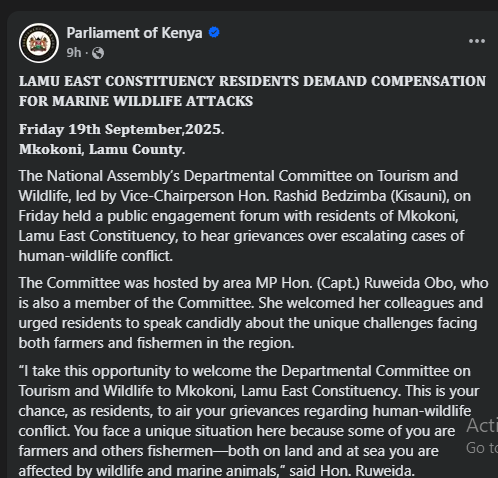
The call comes after the National Assembly’s Departmental Committee on Tourism and Wildlife, led by Vice-Chairperson Rashid Bedzimba, on Friday, September 19, 2025, held a public engagement forum with residents of Mkokoni, Lamu East Constituency, to hear grievances over escalating cases of human-wildlife conflict.
The Committee was hosted by the area Member of Parliament (Capt.) Ruweida Obo, who is also a member. The legislator urged residents to speak candidly about the unique challenges facing both farmers and fishermen in the region regarding the human-wildlife relationship.
“This is your chance, as residents, to air your grievances regarding human-wildlife conflict. You face a unique situation here because some of you are farmers and others fishermen—both on land and at sea, you are affected by wildlife and marine animals,” said Ruweida.
Human-wildlife conflict
Residents painted a grim picture of lives lost, farms destroyed, and livelihoods disrupted due to attacks from both land and marine wildlife.
“We have been greatly affected by wildlife, especially during drought, when they wander in search of water and food. We request an electric fence and water pans to keep animals from destroying our farms,” Mr Obo Chanza, a resident, told the Committee.
He added that the nearby Boni Forest is “heavily infested” with dangerous animals. “People have been mauled by lions and buffaloes, while others suffer from snake bites. The buffalo are numerous and extremely destructive. Worse still, compensation claims take years to be processed,” he lamented.
Beyond land conflicts, residents highlighted marine wildlife attacks that have long been overlooked by authorities. Fishermen narrated ordeals involving sharks, stingrays, starfish, and water snakes. Several victims, they said, have either lost their lives or been left permanently disabled.

“Wildlife is not just the lion, the hyena, or the buffalo. There is wildlife in the water too,” Bakari said, a local fisherman. “Why must they compensate someone bitten by a snake in the bush and refuse to compensate a fisherman bitten by a snake in the ocean? Marine animals like sharks and whales are equally dangerous.”
The residents further accused the Ministry of Tourism and Wildlife, as well as the Kenya Wildlife Service (KWS), of neglecting their plight. They claimed KWS officers in the region are ill-equipped and “immobile,” leaving communities vulnerable.
With some compensation cases dating as far back as 2014 still unresolved, residents pleaded with the Committee to intervene. One example cited was the case of Mr Bakari, who was bitten by a snake in 2015 and pursued compensation for years until his death, without payment.
“Compensation bureaucracy is killing us,” Mr Chanza told the lawmakers. “Our voices are ignored while focus remains only on forest wildlife. But for us, marine animals are just as deadly.”
Mwatate Member of Parliament Peter Shake pledged to escalate the concerns raised during the Mkokoni forum as part of its ongoing inquiry into human-wildlife conflicts across the country.