Koome: Indigenous rights are crucial to protecting Kenya’s forests, wetlands and mangroves
By Faith Lagat, August 5, 2025Chief Justice Martha Koome has reaffirmed the critical role of indigenous rights in protecting Kenya’s fragile ecosystems, calling for a judicial approach that safeguards both environmental and cultural heritage.
Speaking in a recorded address to judges during the Environment and Land Court (ELC) training on carbon offsetting on August 5, 2025, Koome described the protection of indigenous peoples as “absolutely paramount”, praising the ELC for its global leadership in developing carbon offset jurisprudence.
“The protection of the rights of the indigenous people and communities is absolutely paramount,” she noted.
Her remarks come at a time when Kenya’s forests, wetlands, and mangroves face increasing threats from deforestation, land degradation, and climate change.
These landscapes are not only ecological assets but also homes to communities whose identity, spirituality, and survival are intrinsically tied to the land. As such, the Chief Justice emphasised the importance of ensuring that free, prior, and informed consent (FPIC) is upheld—not just as a procedural formality but as a substantive right.
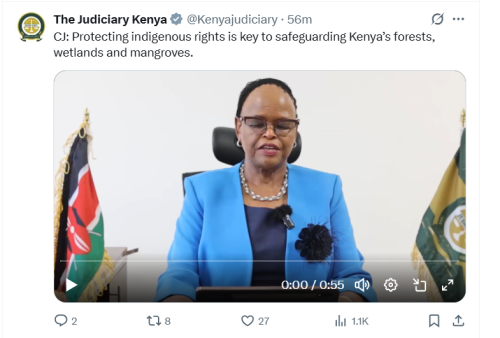
“Many of Kenya’s rich ecosystems, such as our forests, wetlands, and mangroves, are inhabited by communities with deep cultural ties to the land. Our courts must ensure that free, prior, and informed consent is held and upheld at all times, not as a procedural formality, but as a substantive right that safeguards cultural heritage, identity, and self-determination,” read part of the X post by the Judiciary.
Legal backing
Koome’s sentiments align with Kenya’s 2010 Constitution and the Forest Conservation and Management Act of 2016, which promote community participation in the management of natural resources. She cited successful models such as Mikoko Pamoja, a community-led mangrove conservation project in Kwale County, as evidence of the potential that lies in empowering indigenous communities.
However, she also acknowledged the hurdles these initiatives face, particularly in securing long-term funding and improving coordination among stakeholders.
According to Koome, integrating indigenous knowledge and securing land rights are essential if the country hopes to build resilient, community-driven conservation strategies.
Judiciary at the forefront
The Environment and Land Court has emerged as a pivotal player in addressing climate-related land disputes. In her address, Koome commended the court’s recent ruling against a major carbon offset project that had failed to involve local communities, stating that such decisions reflect the judiciary’s evolving role in climate governance.
These judgements, she noted, send a clear message that environmental projects must not come at the expense of indigenous rights. Instead, they must balance conservation goals with equity and inclusion.
As Kenya continues to pursue carbon offsetting and green development, the judiciary’s stance offers a path that protects not just the environment but also the cultural and social fabric of the communities that have long lived in harmony with it.