KNCHR decries lack of funding in identifying protest victims for compensation
By Mustafa Juma, April 1, 2026The Kenya National Commission on Human Rights (KNCHR) has warned that the lack of funding has significantly hampered its ability to conduct nationwide outreach as initially planned, as it works against a tight deadline to develop a national compensation and reparations framework for protest victims.
In a press statement issued on Wednesday, April 1, 2026, the Commission urged the National Treasury to urgently release funds allocated by Parliament to enable it to effectively carry out its mandate.
Without adequate resources, officials say, reaching all affected victims and collecting comprehensive data remains a major challenge.
“The KNCHR has not been able to undertake countrywide outreach as was envisaged and expected by the public due to lack of budgetary allocation. The Commission continues to urge the National Treasury to release the funds allocated by Parliament to the Commission without further delay so that KNCHR can fully discharge this critical constitutional and human rights mandate effectively and efficiently,” KNCHR stated.

KNCHR has called on victims of human rights violations, particularly those affected during protests and demonstrations, to come forward and submit their claims for verification.
The Commission has set Friday, April 3, 2026, as the deadline for submission of supporting documents, including medical reports, police records, post-mortem reports, and witness statements.
In a bid to accommodate more applicants, KNCHR announced that its offices will remain open on the public holiday to receive submissions.
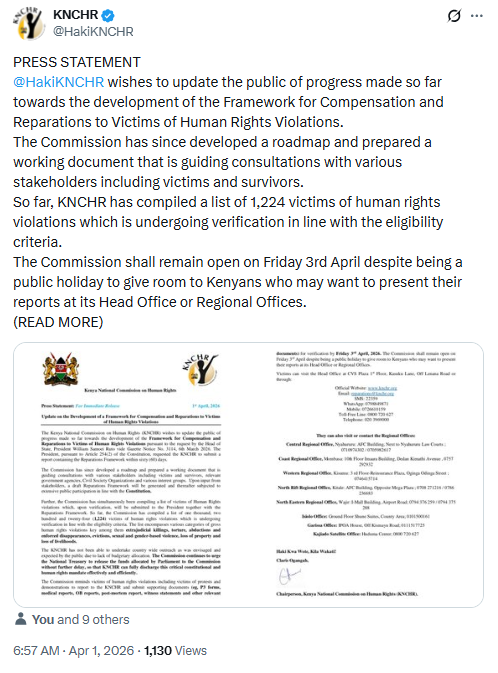
Victims can file their claims at KNCHR’s head office in Nairobi or through its regional offices across the country, as well as via digital platforms including email, SMS, and WhatsApp.
The reparations framework is expected to mark a significant step toward addressing historical and recent human rights violations in Kenya, particularly those arising from protests and state actions.
If successfully implemented, it could provide long-awaited relief to victims while strengthening accountability and institutional response to human rights abuses.
1,224 protest victims listed
The commission has since identified at least 1,224 victims of human rights violations, including those linked to protests and demonstrations.
The Commission said the victims’ list is currently undergoing verification and will form part of a comprehensive report to be submitted to President William Ruto within 60 days, as directed under Gazette Notice No. 3114 of March 6, 2026.
Victims categories
According to KNCHR, the victims fall under multiple categories of gross human rights violations, including extrajudicial killings, torture, abductions, enforced disappearances, evictions, and sexual and gender-based violence, as well as loss of property and livelihoods.
“The Commission has since developed a roadmap and prepared a working document that is guiding consultations with various stakeholders, including victims and survivors, relevant government agencies, Civil Society Organizations, and various interest groups. Upon input from stakeholders, a draft Reparations Framework will be generated and thereafter subjected to extensive public participation in line with the Constitution,” KNCHR stated.
“Further, the Commission has simultaneously been compiling a list of victims of Human Rights violations which, upon verification, will be submitted to the President together with the Reparations Framework. So far, the Commission has compiled a list of one thousand, two hundred and twenty-four (1,224) victims of human rights violations, which is undergoing verification in line with the eligibility criteria. The list encompasses various categories of gross human rights violations, key among them extrajudicial killings, torture, abductions and enforced disappearances, evictions, sexual and gender-based violence, loss of property, and loss of livelihoods.”