KNBS report: Food, fuel, and power costs rise as inflation bites households
By Faith Lagat, October 31, 2025As October rolled in, many households felt that familiar pinch tighten just a little more. Grocery bags, fuel tanks, and electricity bills quietly reminded consumers that budgets were under pressure.
The latest report from the Kenya National Bureau of Statistics, released on October 31, 2025, shows that prices of several everyday essentials edged upward last month, even as a few staples offered temporary relief.
The increases struck hardest at the dinner table, during commutes, and in the glow of home lights after dark.
The kitchen: Inflation on your plate
In the heart of daily life, food prices tell a story of subtle strain. Potatoes, the humble spuds that appear in mashed sides or hearty stews, climbed 1.6% from September, nudging household calculations upward with every meal.
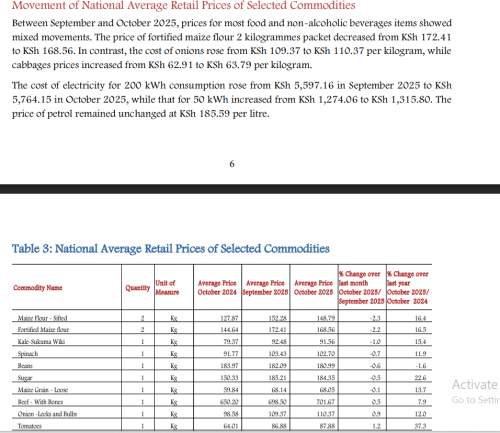
Tomatoes followed, rising 1.2%, while oranges surged the most at 4.2%, turning a simple morning snack into a small negotiation with the wallet. Onions increased from Ksh109.37 to Ksh110.37 per kilogram, cabbages inched up to Ksh63.79, and beef with bones rose a modest 0.5%. These incremental hikes quietly accumulate, testing the resilience of weekly food budgets.
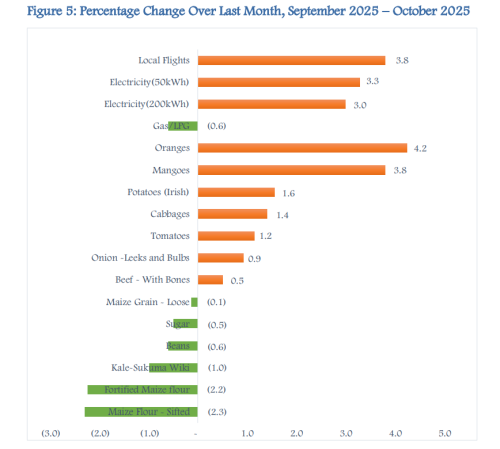
Amid these climbs, a few items offered small reprieves. Sifted maize flour fell 2.3%, its fortified counterpart eased 2.2% from Ksh172.41 to Ksh168.56. Eggs, kale (sukuma wiki), beans, and sugar also saw slight drops between 0.5% and 1.2%.
These reductions are welcome, but they barely offset broader upward pressures, leaving families navigating an overall sense of essentials slipping just out of reach.
Transport and energy
Beyond the kitchen, commuting and energy costs continued their upward creep. Country bus and matatu fares for inter-town travel rose 1.4%, adding extra strain to daily journeys.
Petrol and diesel remained steady at Ksh 185.59 per litre, offering predictability amid change, while international flight fares dipped slightly by 0.6%, a rare nod to accessible wanderlust.
At home, energy bills carried their own mix of relief and worry. LPG prices fell 0.6%, easing the cost of daily cooking. Electricity, however, climbed for most households: 200 kWh rose 3.0%, from Ksh5,597.16 to Ksh5,764.15, and 50 kWh increased 3.3%, from Ksh 1,274.06 to Ksh1,315.80.
“Between September and October 2025, prices for most food and non-alcoholic beverage items showed mixed movements. The price of fortified maize flour 2 kilogrammes packet decreased from KSh 172.41 to KSh 168.56. In contrast, the cost of onions rose from KSh 09.37 to KSh 110.37 per kilogram, while cabbage prices increased from KSh 62.91 to KSh 63.79 per kilogram,” read the KNBS report in part.
Each flick of the switch or hum of a fan now carries a subtle caution, prompting households to consider when and how to use power more efficiently.
Resilience amid rising costs
These monthly shifts, captured in the KNBS report for September to October 2025, reflect a broader pattern of small but meaningful increases across food, transport, and energy sectors.
It’s not a sudden storm but a steady drizzle, nudging households to pause at the till, rethink impulse purchases, and stretch resources creatively.
In navigating these pressures, families demonstrate quiet strength, adjusting meals, sharing resources, and finding small ways to balance rising costs with daily needs.
While October tilted the ledger toward more, it also reinforces the importance of measured choices, resilience, and togetherness. The hope, as November approaches, is that these incremental pressures may ease, allowing households to breathe a little easier while carrying on with life’s daily rhythms.