Kibwana questions legal basis of Ruto’s compensation framework
By Lutta Njomo, August 10, 2025Former Makueni Governor Kivutha Kibwana has joined the list of leaders questioning President William Ruto’s decision to establish a framework for compensating protest victims dating back to 2017.
In a statement on Saturday, August 9, 2025, Kibwana questioned whether the latest presidential proclamation was grounded in law.
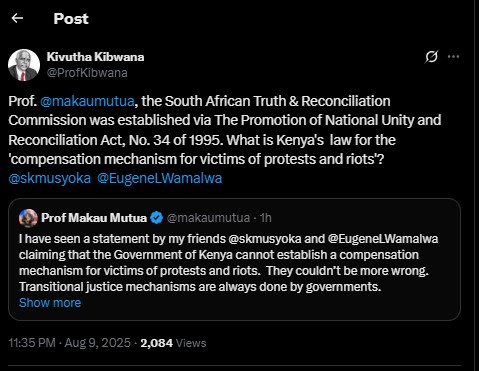
“What is Kenya’s law for the ‘compensation mechanism for victims of protests and riots?” Kibwana posed.
Response to Makau Mutua
Kibwana’s question was triggered by President William Ruto’s Senior Advisor on Constitutional Affairs and Human Rights, Makau Mutua, in defence of the framework after the opposition led by Kalonzo Musyoka and Eugene Wamalwa indicated that the Executive cannot be trusted to handle the compensation issue.
Mutua cited the South African Truth and Reconciliation Commission (TRC), which he maintained was set up to tackle what transpired under apartheid rule.
Responding to Mutua’s argument, Kibwana pointed out that the South African Truth and Reconciliation Commission was established via the Promotion of National Unity and Reconciliation Act, No. 34 of 1995.
The former governor thus challenged Makau Mutua, who was appointed to lead the team to provide a legal framework supporting Kenya’s compensation plan.
Kalonzo’s argument
Addressing the press on Saturday, August 9, 2025, Kalonzo proposed that the Kenya National Commission on Human Rights (KNCHR) should oversee the process.
The opposition, which has been vocal in advocating for compensation, said the government is responsible and cannot be trusted to oversee the exercise.
“Through the shoot-to-kill and shoot-in-the-leg orders, can they be the ones responsible for redress and compensation of their own victims of police brutality? A wolf cannot decide the matters of cow crow. Fisi hawezi kusimamia kesi ya mbuzi,” Kalonzo told the press on Saturday, August 9, 2025.

The opposition demanded a process with a clear roadmap that seeks to create an inclusive committee that will collect views on how much and who are to be compensated.
However, Mutua disagreed with their proposal, insisting that a similar framework was successfully implemented in South Africa.
“I have seen a statement by my friends Kalonzo Musyoka and Eugene Wamalwa claiming that the Government of Kenya cannot establish a compensation mechanism for victims of protests and riots. They couldn’t be more wrong. Transitional justice mechanisms are always done by governments,” Mutua’s statement read in part.
“The most famous of these was the South African Truth and Reconciliation Commission (TRC). The TRC was set up by the Government of National Unity to help deal with what happened under apartheid. As we know, the apartheid era was marked by the most unspeakable abuses and human rights violations meted out especially on Black Africans,” he affirmed.