Kenya sends alert to its citizens in Qatar amid Iran-US strikes
By Kenneth Mwenda, February 28, 2026The Kenyan Embassy in Doha has issued a statement urging Kenyans living in Qatar to remain calm amid heightened tensions in the Middle East.
In the statement, released on Saturday, February 28, 2026, the embassy confirmed it is closely monitoring developments and maintaining contact with Qatari authorities.
The advisory came right after the US and Israel launched a joint attack on Iran early that morning. The operation, known as Operation Shield of Judah, targeted Tehran, Isfahan, Qom, Karaj, and other cities. These strikes targeted nuclear facilities, missile sites, and military installations.
US President Donald Trump announced “major combat operations” and said the goal included destroying Iran’s missile capabilities and preventing nuclear weapon development.
“We are going to destroy their missiles and raze their missile industry to the ground,” Trump said.
Iran responded quickly with widespread retaliatory missile strikes. It targeted US military bases across the Gulf region. Explosions rocked several countries hosting these bases.
In Qatar, Iran aimed at Al Udeid Air Base, which houses over 10,000 US troops and serves as the forward headquarters of US Central Command. Qatari air defences, including Patriot systems, intercepted at least one missile.
Explosions were heard in Doha, and air raid sirens sounded. Bahrain confirmed a missile hit the headquarters of the US Navy’s Fifth Fleet in the Juffair district. Videos showed a massive explosion and a mushroom cloud rising over Manama.

In the United Arab Emirates, air defences intercepted several Iranian missiles, but one person died in Abu Dhabi from shrapnel or related impact. Explosions occurred near Dubai Marina and in the capital. Kuwait reported its air defence systems engaging incoming missiles over its airspace. Ali Al Salem Air Base, which hosts US forces, was among the targets.
Saudi Arabia also faced strikes, with explosions reported in Riyadh. The kingdom condemned the Iranian attacks on its neighbours, including the UAE, Bahrain, Qatar, and Kuwait.
Iran’s Islamic Revolutionary Guard Corps claimed successful hits on multiple US facilities in the Gulf, describing the action as retaliation for the “existential threat” posed by the US-Israeli assault. Unlike a previous 12-day conflict in June 2025, this escalation spread rapidly and without much prior warning to the targeted states.
The strikes disrupted life across the region. Air raid sirens blared in multiple capitals, flights faced diversions, and some schools evacuated. Gulf states, which had tried last-minute diplomacy to avert the attack, now deal with the fallout. Oman’s foreign minister made urgent pleas in Washington just before the strikes.
The disruption unsettled expatriate communities in Doha, including thousands of Kenyans employed in construction, hospitality, and domestic work. In its main statement posted on X at 12:56 PM East Africa Time, the Kenyan Embassy said:
“The Embassy of Kenya in Doha is closely monitoring recent developments in Qatar and the wider Middle East and remains in contact with Qatari authorities. We urge the Kenyan community to remain calm, follow official guidance, and rely on verified government platforms for updates.”
Embassy issues advisory
The embassy followed up in the same thread:
“The Embassy will continue to share updates via our official channels. All Kenyans are encouraged to register through this http://kenyaembassydoha.com/registration/.”
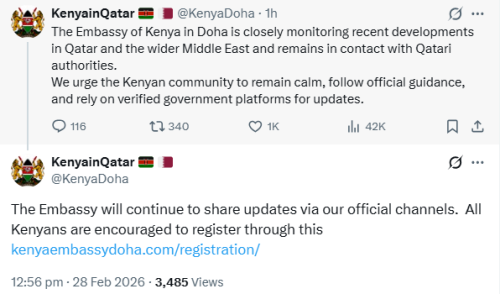
The registration link enables the embassy to account for and assist citizens during emergencies, a standard diaspora support mechanism.
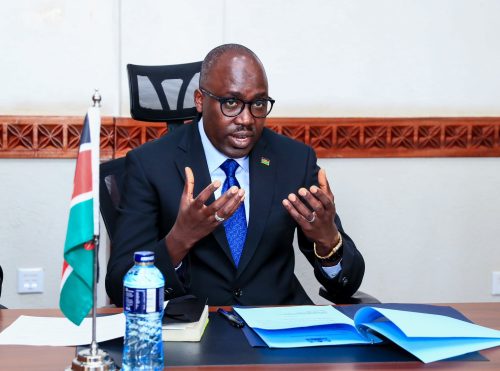
The Kenyan government in Nairobi also weighed in. Foreign Affairs Principal Secretary Korir Sing’Oei posted on X:
“We are following with deep concern the evolving situation in the Middle East and are in close communication with our diplomatic Missions. We urge Kenyans in the region to exercise caution. We stand in solidarity with countries calling for de-escalation and a return to UN Charter-based mechanisms for resolving matters in dispute.”
Earlier, US Secretary of State Marco Rubio said in a press briefing that Iran possesses thousands of short-range ballistic missiles capable of striking US facilities across the Gulf region. He stated:
“As we speak, they possess thousands of short-range ballistic missiles that can reach U.S. bases located in the region, in Saudi Arabia, in Qatar, in Bahrain, in the United Arab Emirates, throughout the region.”
The strikes mark a significant escalation in long-standing tensions between Iran, the United States, and Israel. While Iran views the attacks as violations of its sovereignty, Washington and Tel Aviv have framed their actions as defensive.
Qatar occupies a delicate position. While it hosts key US military assets, it also maintains diplomatic relations with Iran and has historically positioned itself as a mediator in regional disputes.