Kenya reports 70% drop in malaria prevalence – PS Mary Muthoni
By Faith Lagat, April 25, 2026Kenya has recorded a 70 per cent nationwide reduction in malaria prevalence as the world marked World Malaria Day under the theme “Driven to End Malaria: Now We Can. Now We Must.”
Mary Muthoni, the Principal Secretary (PS) for Public Health and Professional Standards in the Ministry of Health, has said the achievement, outlined in the Kenya Malaria Strategy 2023–2027, reflects sustained interventions, strong partnerships, and community-driven efforts aimed at advancing the country’s elimination agenda amid global challenges.
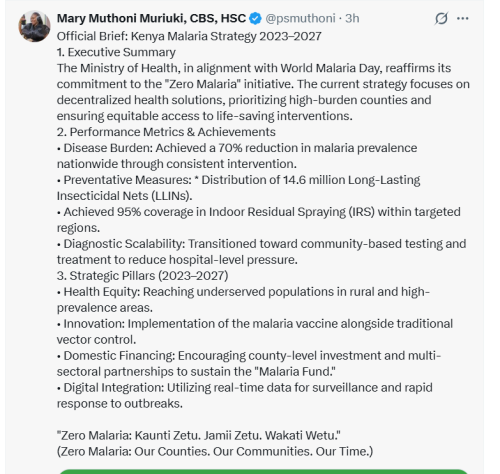
“Performance Metrics & Achievements Diagnostic Scalability: Transitioned toward community-based testing and treatment to reduce hospital-level pressure. Disease Burden: Achieved a 70% reduction in malaria prevalence nationwide through consistent intervention.”
“Preventative Measures: * Distribution of 14.6 million Long-Lasting Insecticidal Nets (LLINs). Achieved 95% coverage in Indoor Residual Spraying (IRS) within targeted regions,” read a statement on Principal Secretary Public Health Mary Muthoni X, dated April 25, 2026.
The World Health Organization World Malaria Report 2025 estimates 282 million cases and 610,000 deaths globally in 2024, a slight increase from the previous year. WHO Director-General Tedros Adhanom Ghebreyesus noted that while progress has slowed, scientific advances continue to offer new hope.
Progress and county-level performance
Kenya’s malaria elimination strategy represents a bold and pragmatic step toward the “Zero Malaria” goal, driven by decentralised, county-led interventions targeting high-burden areas.
The reported reduction is attributed to sustained vector control measures, including the distribution of 14.6 million Long-Lasting Insecticidal Nets and near-complete coverage of Indoor Residual Spraying in targeted zones.
Kirinyaga County has emerged as a leading performer, recording near-zero indigenous malaria cases alongside Nyeri, Nyandarua and Laikipia counties, which are part of the national elimination agenda.
During a courtesy call to Kirinyaga County Commissioner Hussein Allasow ahead of national celebrations hosted in the county, health officials emphasised continued collaboration between National Government Administration Officers and county health teams to safeguard gains and prevent resurgence.
Kirinyaga also hosts one of Kenya’s reference laboratories for malaria surveillance and diagnosis, supporting timely detection and response.
Strategy pillars and implementation
The Kenya Malaria Strategy 2023–2027 is anchored on key pillars, including health equity, innovation through malaria vaccine rollout alongside vector control, domestic financing through the Malaria Fund, and enhanced digital surveillance systems for real-time monitoring.
The country has also shifted towards community-based testing and treatment to ease pressure on health facilities and improve access in rural and high-burden regions.
By emphasising county ownership through “Kaunti Zetu,” community participation under “Jamii Zetu,” and urgency in “Wakati Wetu,” the approach strengthens accountability and resilience at the local level. Health authorities state that the model integrates prevention, diagnosis, and treatment within community systems to sustain gains and improve response capacity.
Global context and outlook
Globally, malaria control efforts continue to face challenges, including insecticide and drug resistance, climate change, and the spread of invasive Anopheles stephensi mosquitoes. The funding gap remains significant, with Ksh 507 billion available against a Ksh 1.21 trillion target in 2024.
Health Cabinet Secretary Aden Duale has emphasised sustainability and reduced donor dependency, while President William Ruto has called for global health reforms aligned with Africa’s priorities.
Despite these challenges, Kenya is advancing local manufacturing, technology transfer, and multi-sector partnerships to strengthen long-term response. Officials say sustained implementation of the strategy could support elimination goals and provide a framework for other African countries in the fight against malaria.