Kenya, California seal historic climate and economic partnership
By Kenneth Mwenda, September 25, 2025Kenya has become the first African nation to sign a climate and economic partnership with the State of California. President William Ruto and Governor Gavin Newsom witnessed the deal on the sidelines of the United Nations General Assembly in New York.
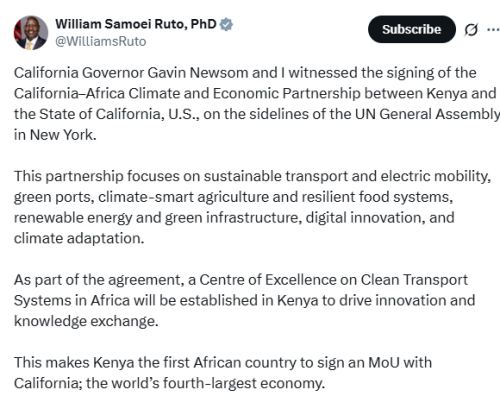
In an X post on Thursday, September 25, 2025, Ruto said the agreement focuses on sustainable transport, renewable energy, climate-smart agriculture, green ports, and digital innovation. It also provides for the creation of a Centre of Excellence on Clean Transport Systems in Kenya to drive research and knowledge sharing across Africa.
“This partnership focuses on sustainable transport and electric mobility, green ports, climate-smart agriculture and resilient food systems, renewable energy and green infrastructure, digital innovation, and climate adaptation,” he wrote.
“As part of the agreement, a Centre of Excellence on Clean Transport Systems in Africa will be established in Kenya to drive innovation and knowledge exchange. This makes Kenya the first African country to sign an MoU with California, the world’s fourth-largest economy.”
California is the world’s fourth-largest economy, and its decision to partner with Kenya is seen as a major diplomatic and economic gain. For Kenya, the deal builds on its ambition to position itself as Africa’s leader in climate action and green innovation. President Ruto has consistently argued that tackling climate change requires bold partnerships between developing and developed economies.
Ruto pushes Africa’s voice
Speaking in New York, he said Africa cannot be left behind in shaping the global response to climate change. He urged the world to invest in African solutions, noting that the continent bears the heaviest costs of climate shocks despite contributing the least to global emissions.
The California partnership was announced after Ruto delivered a strong speech at the UN General Assembly. In his address, he criticised global financial institutions such as the International Monetary Fund (IMF) and the World Bank, accusing them of biased lending practices.
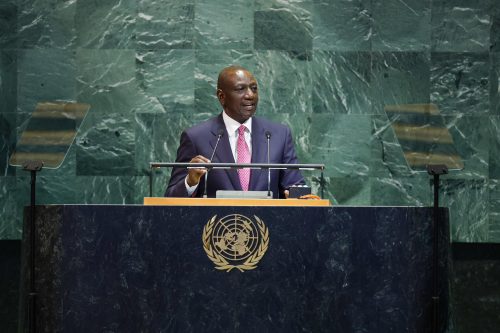
He pointed out that while Africa contributes the largest number of troops to United Nations peacekeeping missions and shoulders the highest costs of instability, it remains the only continent without permanent representation on the UN Security Council. He demanded at least two permanent seats with full rights and two additional non-permanent seats for Africa.
On the IMF, Ruto highlighted that during its recent allocation of Special Drawing Rights, 64 per cent went to wealthy nations with little need for support, while poorer countries received only 2.4 per cent. According to him, this imbalance punishes vulnerable economies with high borrowing costs while rewarding rich nations with easier terms.
“The mismatch between shareholders and stakeholders has become starkly visible. Current systems trap vulnerable economies in cycles of debt, while the prosperous enjoy softer terms. This is unjust and unsustainable,” he said.
Even as Ruto made these remarks in New York, an IMF team began a trip to Nairobi to begin discussions on a possible Fund-supported programme. The mission, led by Haimanot Teferra, will engage the Treasury, the Central Bank, and other stakeholders on Kenya’s fiscal policies, debt management, and economic reforms.