Kenya braces for transport paralysis as nationwide fuel strike begins at midnight
By Mustafa Juma, May 17, 2026Kenya is facing the threat of a major transport shutdown after the Transport Sector Alliance confirmed that a nationwide fuel strike will begin at midnight on Monday, May 18, 2026, in protest against soaring fuel prices.
In a joint statement issued after a high-level consultative meeting held on Sunday, May 17, 2026, the Motorists Association of Kenya said transport stakeholders had declared that no vehicles would operate once the strike takes effect.
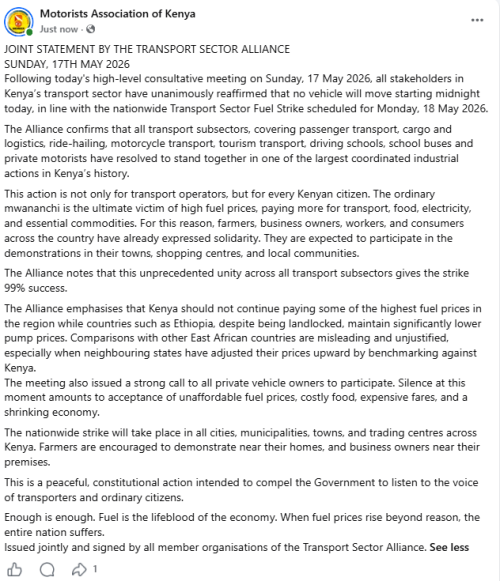
“Following today’s high-level consultative meeting on Sunday, 17 May 2026, all stakeholders in Kenya’s transport sector have unanimously reaffirmed that no vehicle will move starting midnight today, in line with the nationwide Transport Sector Fuel Strike scheduled for Monday, 18 May 2026,” the statement reads in part.
The alliance said all transport subsectors had unanimously agreed to participate in the nationwide strike, including the matatu owners and operators, cargo and logistics transporters, ride-hailing and digital cab operators, motorcycle and boda boda associations, tourist transport operators, driving schools, school transport providers, and private motorists.
The group warned that movement in cities, towns, municipalities, and trading centres across the country could be severely disrupted.
“The Alliance confirms that all transport subsectors, covering passenger transport, cargo and logistics, ride-hailing, motorcycle transport, tourism transport, driving schools, school buses, and private motorists have resolved to stand together in one of the largest coordinated industrial actions in Kenya’s history,” the statement said.
Protest over rising fuel prices
The strike has been triggered by anger over the latest fuel price review announced by the Energy and Petroleum Regulatory Authority, which transport operators say has worsened the cost-of-living crisis.
The alliance argued that rising fuel costs have had a ripple effect across the economy, increasing transport fares, food prices, electricity costs, and operational expenses for businesses.
“This action is not only for transport operators, but for every Kenyan citizen. The ordinary mwananchi is the ultimate victim of high fuel prices, paying more for transport, food, electricity, and essential commodities. For this reason, farmers, business owners, workers, and consumers across the country have already expressed solidarity. They are expected to participate in the demonstrations in their towns, shopping centres, and local communities,” the statement added.

Call for nationwide demonstrations
Transport leaders urged ordinary Kenyans, including farmers, traders, workers, and private vehicle owners, to join demonstrations in solidarity with the strike.
The alliance said protests are expected to take place near homes, business premises, shopping centres, and transport hubs across the country.
“Silence at this moment amounts to acceptance of unaffordable fuel prices, costly food, expensive fares, and a shrinking economy,” the statement read.
99% success expected
The Transport Sector Alliance claimed the strike is likely to record near-total participation due to the unprecedented unity among transport players.
“The meeting also noted that this unprecedented unity across all transport subsectors gives the strike 99% success,” the statement said.
Comparison with regional fuel prices
The alliance also criticised Kenya’s fuel pricing structure, arguing that the country continues to pay some of the highest fuel prices in the region despite economic challenges.
The group cited countries such as Ethiopia as examples of states maintaining lower pump prices despite being landlocked.
The looming shutdown piles further pressure on the administration of William Ruto, which is already facing mounting criticism over the rising cost of living and recent fuel price hikes.
If fully implemented, the strike is expected to disrupt public transport, cargo movement, business operations, tourism, and daily economic activity across the country.
The alliance maintained that the protests would remain peaceful and constitutional, insisting that the action is aimed at forcing the government to address the fuel crisis.