Katiba Institute: Journalists must hold devolution to account
By Sharon Atieno, July 28, 2026Katiba Institute Executive Director Nora Mbagathi has challenged journalists to move beyond reporting political rhetoric and instead scrutinise whether Kenya’s devolved system of government is being implemented as envisioned under the Constitution.
In a post shared on the institute’s X account on Tuesday, July 28, 2026, Mbagathi urged the media to focus on accountability, service delivery and constitutional implementation, arguing that journalists have a critical role in safeguarding devolution by asking hard questions about how county governments exercise power.
“Journalists must go beyond reporting political statements and instead scrutinise whether Kenya’s devolved system of government is being implemented as envisioned under the Constitution.” Nora Mbagathi Said.
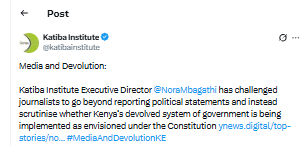
She said reporting should not stop at covering speeches by political leaders but should examine whether devolved institutions are fulfilling their constitutional mandate and delivering services to citizens.
Media’s watchdog role
Mbagathi’s remarks come at a time when debate over governance, accountability and constitutionalism has intensified, with legal experts and civil society organisations increasingly calling for stronger public oversight of government institutions.
Her call echoes recent sentiments by constitutional lawyer Willis Otieno, who maintained that Kenyans do not need to hold public office to scrutinise government or question leaders.
In a statement shared on July 21, Otieno argued that democracy thrives when citizens actively participate in governance, insisting that ideas should be judged on merit rather than on the positions held by those expressing them.
“The Constitution guarantees every Kenyan the right to participate in public affairs, scrutinise leaders and express political opinions,” Otieno said, adding that accountability should never be reserved for elected leaders alone.
Constitutional accountability
Katiba Institute has consistently positioned itself at the centre of constitutional accountability through litigation and public advocacy.
In June, the institute moved to court seeking to have Inspector General of Police Douglas Kanja cited for contempt over the erection of police roadblocks and razor-wire barricades during the June 25 Gen Z anniversary protests.
The organisation argued that the police had defied existing court orders requiring prior public notice before mounting roadblocks, warning that continued disregard for judicial directives undermines the rule of law and weakens constitutional governance.
Mbagathi’s latest appeal reinforces the institute’s long-standing position that constitutional oversight extends beyond the courts and requires active participation by the media and the public.
Her remarks suggest that the success of devolution will depend not only on political leaders and institutions but also on journalists who consistently investigate how public resources are managed, whether county governments remain accountable to citizens, and whether the promises of the 2010 Constitution are being translated into tangible services across the country.