Kanjama reacts to reported US–Iran memorandum
By Faith Lagat, June 19, 2026Law Society of Kenya President Charles Kanjama has commented on the reported US–Iran Memorandum of Understanding.
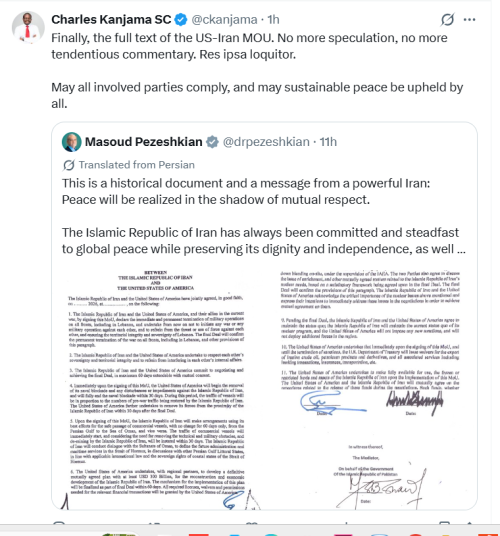
Kanjama, through an X post dated June 18, 2026, reacted to the reported US–Iran Memorandum of Understanding, quoting Iranian President Masoud Pezeshkian’s message and images of the signed document, and emphasized reliance on the agreement’s text in interpreting its meaning.
“Finally, the full text of the US-Iran MOU. No more speculation, no more tendentious commentary. Res ipsa loquitur. May all involved parties comply, and may sustainable peace be upheld by all,” he stated.
Kanjama’s remarks came as global attention focused on the reported agreement, which has been described as a framework aimed at de-escalating tensions between the United States and Iran.
The post circulated widely on social media, drawing reactions from legal and policy observers who highlighted the importance of primary documents in assessing diplomatic developments. Iranian President Masoud Pezeshkian also described the document as a “historical” message emphasizing peace based on mutual respect, sovereignty, and independence.
Key provisions of the reported US–Iran memorandum
The reported agreement, referred to in some sources as the Islamabad Memorandum of Understanding, is said to have been mediated by Pakistan and signed around June 17, 2026. It is structured as an interim arrangement intended to halt hostilities and establish a pathway toward a comprehensive settlement within 60 days, subject to extension by mutual consent.
Key provisions include an immediate cessation of hostilities by all parties and affiliated forces, alongside commitments to refrain from threats or use of force. The agreement also outlines measures concerning maritime security in the Strait of Hormuz, including the facilitation of safe passage for commercial vessels and a phased reduction of military restrictions in the area.
The document further provides for economic and sanctions-related steps, including the issuance of waivers on Iranian oil exports, access to frozen assets, and discussions on reconstruction financing involving regional partners. It also outlines a framework for gradual sanctions termination, subject to agreed timelines.
Nuclear-related provisions reportedly require Iran to reaffirm its commitment not to develop nuclear weapons, with oversight mechanisms involving the International Atomic Energy Agency (IAEA) for monitoring and technical verification. Both sides are said to maintain existing positions during the interim phase while avoiding escalation measures.
Diplomatic framework
The agreement is reported to include an implementation mechanism to oversee compliance and manage negotiations on unresolved issues. These negotiations are expected to begin after initial measures, including ceasefire implementation and easing of maritime restrictions, are undertaken.
A final settlement, once reached, is expected to be presented for endorsement through a binding United Nations Security Council resolution. The framework also emphasizes respect for sovereignty, non-interference in internal affairs, and structured diplomatic engagement as guiding principles.
Reactions to the reported agreement have been mixed across international observers, with some emphasizing its potential to stabilize energy markets and reduce regional tensions, while others raise concerns over verification, enforcement mechanisms, and long-term compliance. The developments continue to attract global attention as parties assess the implementation of the interim framework and its implications for regional security and international diplomacy.