Kanjama calls for urgent action after sharp fuel price rise
By Faith Lagat, May 15, 2026Law Society of Kenya (LSK) President Charles Kanjama has called on the government to urgently introduce additional measures to cushion Kenyans following the latest fuel price increase announced by the Energy and Petroleum Regulatory Authority (EPRA).
In a statement issued on Friday, May 15, 2026, Kanjama warned that the sharp rise in fuel prices, particularly the Ksh 46.29 increase in diesel prices, would intensify pressure on households, public transport, small businesses, and the overall cost of living.
EPRA announced that fuel prices effective from May 15 to June 14, 2026, would see super petrol increase by Ksh 16.65 per litre while diesel rose by Ksh 46.29 per litre. Kerosene prices remained unchanged after government subsidies.
According to EPRA, the adjustments were driven by rising global landed costs of imported petroleum products. The average landed cost of super petrol increased by 10 per cent from about Ksh106,279 to Ksh116,904 per cubic metre between March and April 2026.
Diesel recorded a steeper 20.32 per cent increase from about Ksh138,523 to Ksh166,665 per cubic metre, while kerosene rose by 1.99 per cent from approximately Ksh169,239 to Ksh171,922 per cubic metre.
The government is using approximately KSh5 billion from the Petroleum Development Levy (PDL) Fund to cushion diesel and kerosene consumers.
Kanjama acknowledged the subsidy but maintained that more intervention was needed.
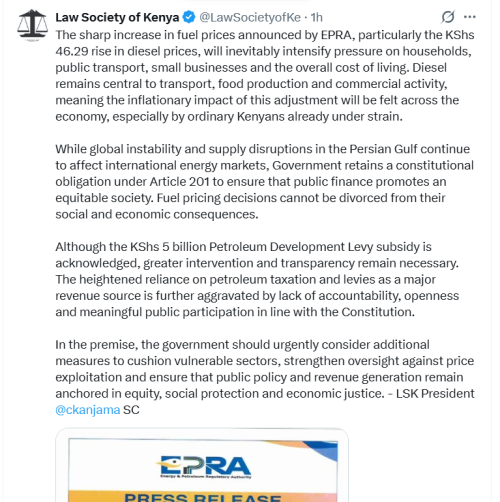
“Diesel remains central to transport, food production and commercial activity, meaning the inflationary impact will be felt across the economy, especially by ordinary Kenyans already under strain,” he said.
LSK calls for transparency and public participation
The LSK president said fuel pricing decisions could not be separated from their economic and social consequences, particularly at a time when many Kenyans are struggling with the high cost of living.
He cited Article 201 of the Constitution, which requires public finance systems to promote an equitable society, and urged the government to strengthen transparency and accountability in fuel pricing.
Kanjama further criticised what he described as growing reliance on petroleum taxation and levies as a source of government revenue without sufficient public participation.
“Although the KSh5 billion Petroleum Development Levy subsidy is acknowledged, greater intervention and transparency remain necessary,” he stated.
He also called for stronger oversight to prevent exploitation by market players following the latest increase.
Debate grows over fuel pricing system
The latest fuel price review has renewed debate over Kenya’s monthly fuel pricing mechanism and the impact of global market instability on local consumers.
Rongo MP Paul Abuor has already proposed amendments to the Petroleum Act 2019 to allow emergency fuel price reviews every 14 days during periods of global volatility instead of the current 30-day cycle.
The proposal would allow the Energy Cabinet Secretary, in consultation with EPRA, to introduce temporary pricing periods aimed at responding faster to fluctuations in international oil markets.
Kanjama said the government must ensure that public policy and revenue generation remain anchored in equity, social protection, and economic justice as global fuel markets remain volatile.