Kabogo dismisses claims of regional bias in grade 10 placement
By Faith Lagat, January 11, 2026Cabinet Secretary for Information, Communications, and the Digital Economy William Kabogo has dismissed claims of regional bias in the recent Grade 10 school placement under Kenya’s Competency-Based Curriculum (CBC), saying the process was automated to ensure fairness and transparency.
In a statement shared on his official X account on January 11, 2026, Kabogo said the system was designed to eliminate human interference and guarantee equal opportunity for learners across the country.
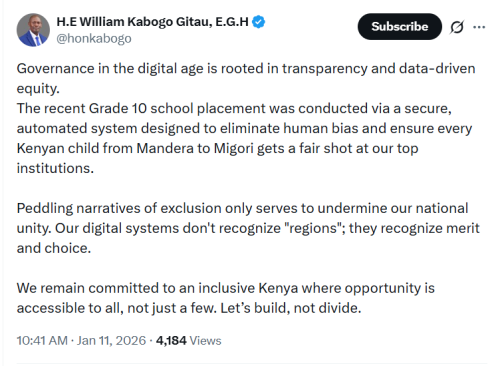
“Governance in the digital age is rooted in transparency and data-driven equity. The recent Grade 10 school placement was conducted via a secure, automated system designed to eliminate human bias and ensure every Kenyan child from Mandera to Migori gets a fair shot at our top institutions,” Kabogo wrote.
Govt defends automated placement system
The CS rejected claims that certain regions were excluded from national schools, warning that such narratives risk fuelling unnecessary divisions.
“Peddling narratives of exclusion only serves to undermine our national unity. Our digital systems don’t recognise ‘regions’; they recognise merit and choice,” he stated.
Kabogo reaffirmed the government’s commitment to inclusivity, adding, “We remain committed to an inclusive Kenya where opportunity is accessible to all, not just a few. Let’s build, not divide.”
The remarks come amid heightened public debate over the Grade 10 placements, which marked the first major transition to senior secondary education under CBC following the Kenya Junior Secondary Education Assessment (KJSEA) conducted in late 2025.
The placement exercise has drawn scrutiny from parents and leaders questioning why some high-performing learners were assigned to schools far from their home regions.
Political reactions fuel national debate
The controversy intensified after Democracy for the Citizens Party (DCP) leader Rigathi Gachagua questioned the fairness of the admissions, particularly into national schools in the Mt Kenya region. He argued that some top-performing learners were overlooked, calling for greater accountability in the placement process.
His remarks drew criticism from Chama Cha Kazi Party leader Moses Kuria, who accused him of introducing tribal considerations into education policy. President William Ruto also defended the placement system, urging leaders to avoid politicising the transition.
Former Mukurweini MP Kabando wa Kabando, however, publicly supported Gachagua’s position. In a post dated January 20, 2026, Kabando described the call for scrutiny as “noble”, saying, “DCP Leader’s call for accountability on a basic, critical national education policy is noble. Equity in high school admissions is about integrative justice for all of Kenya’s students. Leaders robbing their constituents must be shamed. Charge them! Jail them! Kudos, RiggyG!”
Kabando further urged persistence, stating, “Dear Riggy G, Kindly, no relenting on the matter of national schools admissions equity. The majority of Kenyans have your back on this agenda. Spot on! The proposal is apt. Only thieving elected leaders are cowed… education is a right.”
In response to public concerns, the Ministry of Education reopened the placement portal between January 6 and 9, 2026, to allow reviews and adjustments. Education CS Julius Migos Ogamba has urged calm, maintaining that placements are merit-based while accommodating practical considerations as Kenya completes the CBC transition.