Justina Wamae blames voters for ineffective leadership
By Faith Lagat, August 16, 2025Former Roots Party deputy presidential candidate Justina Wamae has stirred debate with a bold critique of Kenya’s political leadership, arguing that voters bear responsibility for ineffective governance.
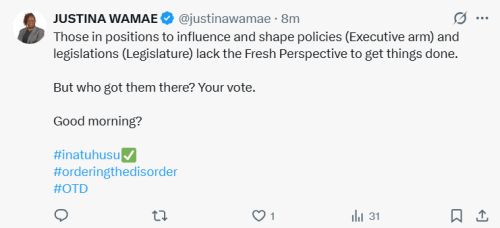
In a post on her official X account on Saturday, August 16, 2025, Wamae stated, “Those in positions to influence and shape policies (Executive arm) and legislations (Legislature) lack the fresh perspective to get things done. But who got them there? Your vote.”
Her comments resonate amid growing public frustration following the June 2025 youth-led protests and the escalation of the Saba Saba demonstrations.
Leadership gaps
Wamae’s critique extends to systemic flaws in political leadership, echoing observations by former nominated senator Gloria Orwoba, who has highlighted integrity challenges within Parliament. Orwoba contends that the legislative arm often functions as a platform for political ambition rather than meaningful reform.
“Our Parliament does not prepare you to change the country; it prepares you to cut deals,” she wrote, suggesting aspiring reformers may find better grounding in the Executive or Judiciary. This perspective aligns with a 2024 World Bank report noting slow progress in achieving devolution goals under Kenya’s 2010 Constitution due to entrenched political interests.
Calls for voter engagement
Linking her critique to ongoing national unrest, Wamae urged Kenya’s Gen Z to channel protest energy into voter registration and participation ahead of the 2027 elections. Reflecting on the Saba Saba protests, which disrupted businesses and claimed lives, she lamented, “I don’t know if it’s Gen Zs or Goon Zs paid by the government who are looting, but how I wish this energy would have been put into voter registration.”
Wamae argues that Kenya’s fundamental challenge is a lack of economic democracy, which can only be addressed by electing leaders committed to job creation and development-focused policies.
Her comments have sparked mixed reactions. Supporters commend her call for accountability and citizen responsibility, while critics argue she oversimplifies complex systemic issues, including historical mistrust and partisan gridlock, as noted in the Open Society Foundations’ 2023 report on Kenyan democracy.
As public discourse unfolds, Wamae’s emphasis on voter-driven change could influence Kenya’s political landscape ahead of 2027, adding momentum to ongoing calls for national dialogue from leaders such as Raila Odinga.