Advertisement
Journalist trades pen for BT cotton farming
Tuesday 29th March, 2022 12:12 AM|
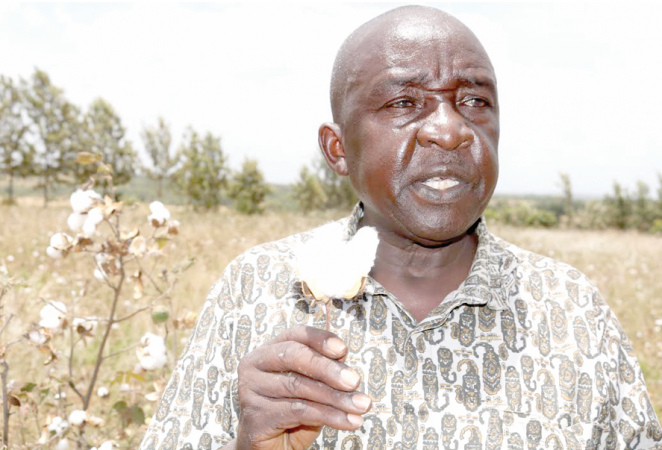
When the genetically modified cotton variety (BT Cotton) was introduced in Kirinyaga County for trials in 2001, Munene Kamau was among the first people to witness that milestone.
At the time, he was a journalist at a local newspaper, but the prospects of a bountiful harvest made him venture into farming 20 years later in 2021. He is among the 1,000 farmers who pioneered the planting of BT cotton within Mwea area after the government legalised commercial cultivation of the crop in 2020.
“After watching the whole process from trials to legalisation and seeing the benefits the crop possessed, I fell in love with it.I even decided to be one of the pioneer farmers. The reason being, I wanted to help revive the cotton industry, which had totally collapsed in Kirinyaga County, as well as to save Kenyans from the mitumba bondage,” says the 63-year-old farmer.
Some of the benefits of BT cotton, include resistance to bollworm and can improve farmers’ production eight times, from the current yields of 30,000 to 240,000 bales a year, which is much more compared to over 70,000 bales produced in 1985 when the sector was thriving. BT cotton is also resistant to drought. With BT cotton, insect pressure is also very low. One requires to spray the crop only two times unlike the conventional varieties that require one to spray at least 15 times.
When he cultivated BT cotton mid last year for the first time, people made fun of him for venturing into a new crop that nobody else was growing. Because of that, he was and still is the sole BT cotton farmer in the whole of South Ngariama, an area that covers approximately 28,000 hectares (69,189 acres). While other farmers are still struggling with poor yields from maize farming, Munene has started smiling after seeing the performance of his second crop.
“I have realised that if one follows good agronomic practices, they are assured of maximum yield from this crop. The more balls a crop has the better. For BT cotton, one crop can have as many as 60 balls per stem while the conventional one can only produce 10 balls at most.”
No manure
He reveals that the first crop failed terribly because he only managed to harvest cotton worth Sh2,700 from his three acre piece of land, which is under BT cotton. However, there is light at the end of the tunnel because the second crop looks promising.
“So far I have harvested about nine bags and I am not yet done. I only managed three bags for the first harvest. The reason I got total crop failure the first time is because of incorrect information,” he admits.
He revealed that, after initial support of nine packets of seeds by the seed company, they were advised not to use manure or fertilizer.Poor soil nutrition as well as little rainfall the area received resulted in total crop failure.
From that experience he has learnt that soil nutrition and good agricultural practices is paramount in BT cotton farming. One also needs to water the crop regularly if there is no rain have maximum yield. To ensure that he never experiences total crop failure again, he is planning to sink a borehole and put his crops under irrigation.
“We got the wrong information from the word go and this really costed us. If it was not for that, I wouldn’t have registered a total crop failure. Though things have changed with the second crop, I want to ensure that for the subsequent crops my farm becomes a model farm,” he says.
And what are some of the challenges has he been facing along the way? He says that the major challenge is lack of extension services as he is always forced to walk for about 20 kilometres to the nearest Kenya Agricultural Research Institure (KARLO) offices to get help. Apart from that, there is no ready market for the produce since Mwea ginnery has not been revived despite promises by the government to revive it. Apart from that, farmers are also experiencing a lot of post-harvest losses, because of poor storage and transportation.
“We are forced to store our produce at home as we wait for buyers from Kitui or Meru counties. Lack of ready market for the produce is one of the reasons farmers are shying away from embracing this crop. The price is also bad with a kilogramme fetching Sh17 only, yet the cost of production is way higher than this.”
High seed prices
If production goes up and more farmers venture into BT cotton farming, he says the government will be forced to revive the ginnery. Apart from that, the government also needs to sink more boreholes to help farmers. The cost of seeds should also be lowered to ensure that more farmers venture into this farming. Currently, seed prices are keeping farmers at bay since few can afford them and the government is no longer providing the seeds for free.
“A two-kilogramme packet of BT cotton seeds goes for Sh4,000. An acre requires three or two-kilogramme packet. Very few farmers have such buying power. The prices should also be reviewed to favour most of the farmers who are willing to start farming, but the cost keeps them at bay.,” he says.
He reveals that when he ventured into BT cotton farming, he expected to find the whole value chain already set. Unfortunately, this was not the case since even the experts who were supposed to be frequenting their farms were not readily available to guide them. Their absence made the pioneer farmers like him to learn the hard way.
“Initially the government had promised a ready market but the reality dawned when I started to harvest. There was no market. I was forced to rely on middlemen. My first harvest was about 47 kilogrammes yet I was hoping to harvest at least four tonnes (4000 kilogrammes). However, this never demoralised me,” he says in conclusion.
Author
Milliam.Murigi
View all posts by Milliam.MurigiLatest News








Advertisement