Advertisement
Itumbi opposes NACADA proposal to ban alcohol ads by content creators
Wednesday 30th July, 2025 08:14 PM|

Dennis Itumbi, the head of Presidential Special Projects and Creative Economy Coordination in President William Ruto’s government, has come out strongly against the proposal by the National Authority for the Campaign Against Alcohol and Drug Abuse (NACADA) to bar content creators from promoting alcohol products.
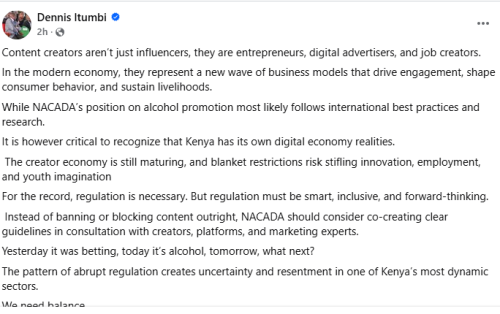
In a statement posted on his Facebook page on Wednesday, July 30, 2025, Itumbi said that content creators are more than just influencers.
He described them as entrepreneurs, digital advertisers, and job creators who play a critical role in the modern economy. According to him, content creators represent a new wave of business models that drive engagement, shape consumer behaviour, and sustain livelihoods.
Itumbi noted that NACADA’s position on alcohol promotion most likely follows international best practices and research. However, he argued that it is important to recognise Kenya’s unique digital economy realities.

You Might Also Like


He explained that the creator economy is still maturing and that blanket restrictions risk stifling innovation, employment, and youth imagination.
He emphasised that regulation is necessary but must be smart, inclusive, and forward-thinking. He urged NACADA to avoid outright bans or blocking of content and instead work with creators, digital platforms, and marketing experts to develop clear and practical guidelines that support both public health and the growth of the creator economy.
“In the modern economy, they represent a new wave of business models that drive engagement, shape consumer behaviour, and sustain livelihoods. While NACADA’s position on alcohol promotion most likely follows international best practices and research. It is, however, critical to recognise that Kenya has its own digital economy realities.” Itumbi said.
Itumbi warned that a pattern of abrupt regulation, like what has been witnessed in previous restrictions, creates uncertainty and resentment in one of Kenya’s most dynamic sectors. He highlighted that yesterday it was betting, today it is alcohol, and he questioned what would come next if this trend continued.
He called for a balanced approach where public health priorities are respected but the digital economy is not sacrificed. He insisted that the focus should not be on shutting down the trade but on shaping it responsibly so that it can continue to support jobs, businesses, and livelihoods.
“The creator economy is still maturing, and blanket restrictions risk stifling innovation, employment, and youth imagination. For the record, regulation is necessary. But regulation must be smart, inclusive, and forward-thinking.” He added.
NACADA’s proposal
This comes on the heels of NACADA’s intensified efforts to combat alcohol and drug abuse in Kenya, culminating in the proposed National Policy for the Prevention, Management, and Control of Alcohol, Drugs, and Substance Abuse, launched on July 30, 2025. The policy targets content creators, influencers, celebrities, and media personalities, prohibiting them from endorsing alcoholic products, with advertising restricted to individuals aged 25 and above.
It also bans online and social media alcohol promotions, including those originating from outside Kenya, and imposes a watershed restriction on alcohol advertisements between 5:00 am and 10:00 pm on audio-visual platforms.
Additional measures include prohibiting alcohol branding on children’s merchandise and promotions with incentives such as free samples.
Author
Latest News








Advertisement
More on News