Iran Embassy in Nairobi defends navigation policy in Strait of Hormuz amid ongoing war
By Faith Lagat, March 28, 2026The Embassy of the Islamic Republic of Iran in Nairobi has defended its navigation policy in the Strait of Hormuz amid the ongoing regional war, saying maritime traffic through the strategic waterway has not been closed.
In a press release issued on March 27, 2026, the embassy rejected claims that the Strait had been shut and attributed instability in the maritime domain to what it described as illegal military aggression by the United States and Israel.
The embassy said the current situation in the region had become “highly unsafe, volatile, and unpredictable,” linking the developments to actions by the US and Israel with assistance from certain littoral states in the Persian Gulf.
“A highly unsafe, volatile, and unpredictable situation has arisen in the region’s maritime domain as a direct result of ongoing illegal military aggression by the US and the Israeli regime.”
Iran blames aggression for instability
According to the statement, the actions by the US and Israel constitute a violation of Article 2(4) of the United Nations Charter, which prohibits the threat or use of force against the territorial integrity or political independence of a state.
“This aggression carried out and continued with the aid and assistance of third parties, including certain littoral States of the Persian Gulf, constitutes a clear violation of Article 2(4) of the Charter of the United Nations.”
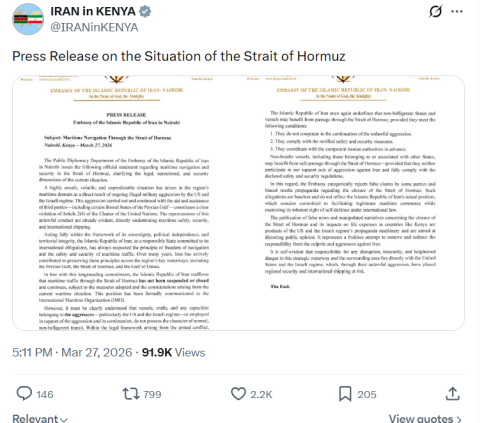
The embassy said the consequences of the conflict had already affected maritime safety, security and international shipping in the region.
Despite the tensions, Iran maintained that it remains committed to international obligations, including respecting freedom of navigation.
The statement noted that Iran has historically contributed to maintaining safety in key waterways, including the Persian Gulf, the Strait of Hormuz and the Gulf of Oman.
It added that maritime traffic through the strait “has not been suspended or closed” and continues under measures adopted in the current wartime situation. The embassy said this position had been formally communicated to the International Maritime Organization.
Conditions for vessel passage
The embassy stated that non-belligerent states and vessels may continue to benefit from passage through the Strait of Hormuz under specific conditions.
According to the statement, vessels must not cooperate in what it described as unlawful aggression against Iran, must comply with notified safety and security measures and must coordinate with competent Iranian authorities in advance.
However, the embassy said vessels linked to the “aggressors,” particularly those belonging to the US and Israel or supporting the ongoing conflict, would not enjoy the character of normal transit.
It stated that such assets would be handled in accordance with the decisions and measures of Iranian authorities within the legal framework of the armed conflict.
Embassy rejects closure claims
The embassy also rejected reports suggesting that the Strait of Hormuz had been closed, describing such claims as false and misleading.
It said reports linking the alleged closure to rising living costs in countries such as Kenya were part of “biased media propaganda.”
The statement described such narratives as attempts to distort public opinion and shift responsibility for insecurity in the region.
The embassy further stated that responsibility for any disruption or heightened danger in the strategic waterway lies with the United States and Israel due to their actions in the ongoing conflict.
The Strait of Hormuz is one of the world’s most critical shipping routes, handling a significant portion of global oil shipments and international maritime trade.