Inside Alternative Govt’s calculation of the 2026/27 budget
By Kenneth Mwenda, June 11, 2026Kenya’s 2026/27 national budget has triggered a heated political and economic debate after the opposition unveiled an alternative spending plan that sharply contrasts with the government’s proposals.
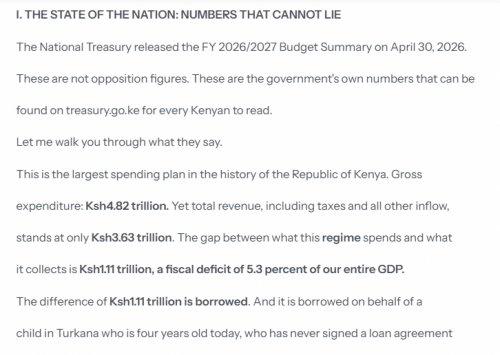
The opposition, under the United Alternative Government led by Wiper Party leader Kalonzo Musyoka, is calling for a reduction of the national budget from Ksh4.82 trillion to Ksh4.318 trillion, arguing that the current plan is too large and will increase debt pressure on ordinary citizens.
The government, on the other hand, defends the budget as necessary to fund key sectors such as education, health, infrastructure, and security. Treasury Cabinet Secretary John Mbadi says the process followed extensive public participation and reflects the needs of Kenyans across the country.
Opposition calls for leaner budget
Here is a grammatically improved version:
According to a press statement released on Wednesday, June 11, 2026, the opposition says the current budget is unsustainable and heavily dependent on borrowing. It warns that the government plans to finance a fiscal deficit of about Ksh1.11 trillion mainly through loans, which will increase Kenya’s public debt and future tax burdens.
Kalonzo Musyoka said the alternative budget aims to reduce waste while protecting essential services. He argued that the government can still raise sufficient revenue through improved tax compliance instead of introducing new taxes.
According to the opposition plan, revenue would rise to Ksh3.725 trillion, while the deficit would drop to Ksh593.5 billion, or about 2.8 per cent of GDP. Domestic borrowing would also fall to Ksh500 billion, nearly half of what the government proposes.
Kalonzo said the goal is to reduce pressure on the domestic credit market.
“We shall halve the pressure on T-bill rates and private sector credit in year one,” he stated.
Education funding at the centre of debate
Education remains one of the most contested areas in both budgets. The opposition proposes increasing education funding to Ksh737.3 billion, higher than the government’s allocation.
It also wants to fully fund free primary and secondary education, ensuring no hidden costs for parents. The plan sets aside statutory capitation of Ksh1,420 per pupil for primary schools and Ksh22,244 per secondary school student.
The opposition also proposes full funding for Junior Secondary Schools and a revival of the Kenya School Equipment Scheme. It further suggests cutting about Ksh22.4 billion from administrative costs within the education ministry and redirecting the money to classrooms.
“Free means free. All the way from Class One to Form Four,” Kalonzo said.
Treasury CS John Mbadi, however, has defended government spending on education, noting that allocations have steadily increased in recent years. He said education funding rose from Ksh526 billion in 2021/22 to Ksh784.5 billion in the 2026/27 budget. He also pointed to increased recruitment of over 100,000 teachers and higher capitation support.
Health sector reforms and funding clash
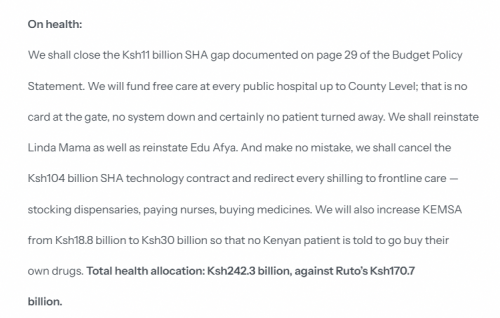
Health is another major area of disagreement. The opposition proposes raising health funding to Ksh242.3 billion from the government’s Ksh170.7 billion.
The plan focuses on strengthening frontline services. It proposes closing an Ksh11 billion gap in the Social Health Authority (SHA) funding, reinstating programmes such as Linda Mama and Edu Afya, and increasing funding for the Kenya Medical Supplies Authority (KEMSA) from Ksh18.8 billion to Ksh30 billion.
One of the most controversial proposals is the cancellation of a Ksh104 billion SHA technology contract. The opposition argues that the funds should instead go directly to hospitals, drugs, and healthcare workers.
“No patient should be turned away,” Kalonzo said while presenting the plan.
Borrowing, debt, and economic pressure
The biggest difference between the two budgets lies in borrowing strategy. Kenya continues to run large fiscal deficits, which require both domestic and foreign borrowing.
The government’s plan relies heavily on domestic borrowing of nearly Ksh1 trillion. Critics argue this crowds out private sector lending, making credit more expensive for businesses and individuals.
Banks often prefer lending to the government due to lower risk and stable returns. As a result, fewer funds are available for businesses seeking loans to expand operations or for households applying for mortgages and development loans.
The opposition says its reduced borrowing plan would ease this pressure. By lowering domestic borrowing to Ksh500 billion, it argues that more credit would flow to the private sector, supporting job creation and investment.
Government defends its fiscal strategy
Treasury CS John Mbadi has dismissed claims that the government is overspending. He says the budget reflects public participation and long-term development needs.
Mbadi explained that the budget process began months earlier and involved consultations across counties, including meetings with youth groups, traders, and informal sector workers. He said the government has tried to open up the Treasury to public input.
“We are making sure that what is spelt out in law is actually done,” Mbadi said.
He also rejected claims that education is being underfunded, insisting that total allocations have increased and that reforms in staffing and capitation show clear progress.
The debate over the budget goes beyond politics and into real economic impact. A higher deficit means more borrowing, which increases debt servicing costs. These costs reduce the amount of money available for development projects such as roads, hospitals, and schools.
On the other hand, a smaller deficit could reduce pressure on interest rates and improve private sector access to credit. This could support small businesses, agriculture, and manufacturing growth.
However, critics of the opposition plan question whether the proposed revenue gains from “compliance” are realistic without introducing new taxes.
For ordinary Kenyans, the debate affects daily life in several ways. Education funding determines whether parents pay additional school levies. Health funding affects access to medicines and hospital services. Borrowing levels influence interest rates on loans and the cost of living.
High public debt also means more government revenue goes to interest payments instead of services. This reduces fiscal space for development projects that directly benefit citizens.