IG Kanja: Court orders must align with public interest
By Faith Lagat, August 22, 2025The delicate balance of power between Parliament and the Judiciary came under sharp focus on Friday, August 22, 2025, during a high-level retreat of Kenya’s top leadership at the Serena Hotel in Mombasa.
The event, themed “Social Transformation through Institutional Comity,” marked the 3rd Leadership Retreat of the 13th Parliament and brought together key figures including Inspector General of Police Douglas Kanja, Chief Justice Martha Koome, and National Assembly Speaker Moses Wetangula.
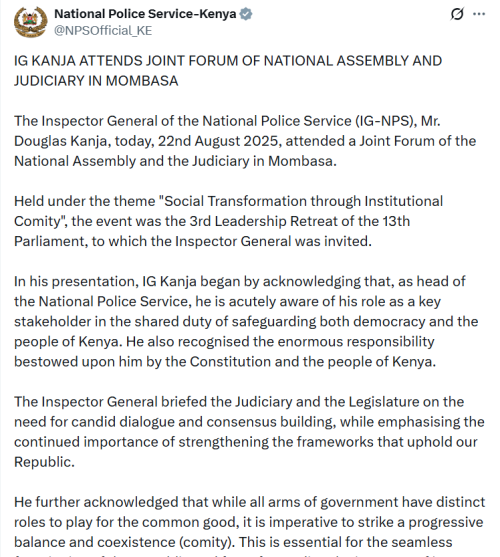
IG Kanja stirred debate with remarks urging the Judiciary to ensure court orders are not only reasonable but also aligned with the public interest and the common good.
Judiciary and public interest
In his address, Kanja underscored the importance of judicial decisions resonating with citizens, warning against rulings that appear detached from societal needs. “Court orders should be reasonable and aligned with the public interest,” he stated, according to an official National Police Service post on X.
The IG’s comments reopened debate on the Judiciary’s autonomy. A 2021 Journal of African Law study noted that nearly 70 percent of Kenyan court rulings faced public backlash, raising questions over whether the Judiciary is sufficiently in tune with public sentiment.
Kanja stressed his constitutional duty as head of the Police Service to safeguard democracy and protect the people, calling for candid dialogue and consensus-building between arms of government. He described this collaboration as essential for “the Republic’s seamless functioning.”
Push for resources
Beyond the Judiciary debate, Kanja also pressed Parliament to prioritise funding for the Police Service to combat emerging threats. He highlighted transnational crimes such as cybercrime and human trafficking, noting the urgent need for additional human capital, advanced training, and logistical support.
“Such funding would be instrumental in increasing the Service’s capacity and enabling continuous personnel training,” the IG emphasized. His remarks align with a 2022 UNODC Global Report that recorded a 350 percent surge in cybercrime cases in East Africa since 2018.
Lawmakers push back
The retreat also exposed friction between Parliament and the Judiciary. Otiende Amollo, a member of the Justice and Legal Affairs Committee, cautioned courts against interfering with legislative work. “Courts should not injunct Parliament in law-making; they should only await the outcome to determine constitutionality,” he said in a separate post on X.
Speaker Wetangula echoed the concerns, criticizing conservatory orders that stall parliamentary processes, describing them as a matter that requires urgent judicial reflection. He, however, framed the retreat as a turning point in strengthening institutional cooperation “for the good of the citizens.”
As discussions continue, the call for court orders to reflect public interest is likely to redefine the dynamics of governance in Kenya, with stakeholders expressing hope for a more collaborative and progressive balance among the country’s key institutions.