IEBC seeks Ksh502M funding to expand diaspora voting ahead of 2027 elections
By Ndiritu Wanjiru, April 17, 2026The Independent Electoral and Boundaries Commission (IEBC) is concerned about dismal diaspora voter registration and structural obstacles despite intensifying preparations to increase involvement in the 2027 General Election.
Taking it to their social media accounts on Thursday, April 16, 2026, the parliament noted that when acting CEO Moses Sunkuli appeared before the Diaspora Affairs and Migrant Workers Committee, he pointed out a marked difference between the approximate number of Kenyans in the diaspora, Ksh1.4 million, and the number of Kenyans who had registered to vote in the 2022 elections (10,443). The turnout among registered voters was 57.76 per cent.
“The Commission is unable to carry out any diaspora mapping and registration activities due to the unavailability of funding in the current financial year,” Sunkuli said.
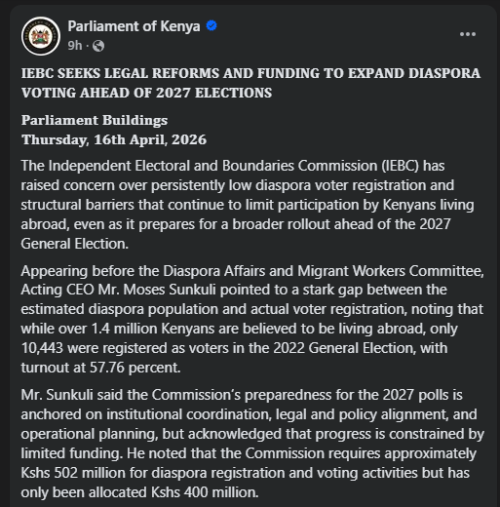
Sunkuli observed that the preparedness strategy developed by the commission in 2027 is based on the alignment of legal and policy, institutional coordination, and operational planning, but progress is limited due to insufficient funding.
To conduct diaspora mapping, registration and voting, the IEBC needs about Ksh502 million, yet it has been allocated Ksh400 million. This has seen no mapping or registration activities carried out during the current financial year.
He informed the committee that they are still trying to get funding with the Justice and Legal Affairs Committee in the coming financial year and that they might start mapping and registering as soon as the resources are available.
There are still legal and logistical obstacles to growth. The diaspora registration and voting are restricted to the countries that have Kenyan embassies or consulates by Regulation 34 of the Elections (Registration of Voters) Regulations, which practically restricts access.
The Commission cautioned that the clause puts undue limitations on the constitutional right to vote and is demanding amendments to enable a more accommodative and inclusive practice.
IEBC to expand diaspora countries
Accessibility issues of the Kenyan workers in foreign countries were also an area of concern for the lawmakers. Justus Kemei has used some instances in Saudi Arabia, which have led to some workers allegedly being unable to control their passports.
Rashid Bedzimba wanted clarification on whether the national identity cards could be used as alternative identification. Director of Legal Services at the IEBC, Chrispine Owiye, stated that the use of IDs beyond the East African region had been questioned in a court, with a 2022 decision in the High Court declaring its use invalid.
The Commission is also pursuing the Supreme Court of Kenya’s directives to gradually increase the diaspora voting over the electoral cycles.
Simon King’ara, who is the committee vice-chairman, encouraged the commission to enhance awareness among the people and raise more polling stations to overcome the long queues experienced during past elections.
The IEBC continued to argue that the only way to deepen the involvement of the diaspora can be achieved through legal reform, adequate funding, increased inter-agency cooperation and long-term voter education and that without these measures, limited progress will be achieved.