Advertisement
How times have changed: Irungu Nyakera says Kibra is now safer than Githurai during protests
Tuesday 07th July, 2026 09:34 AM|

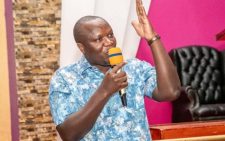
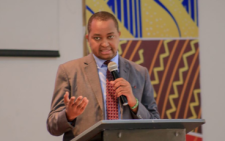
Former Kenyatta International Convention Centre (KICC) Chairman Irungu Nyakera has sparked fresh debate over Kenya’s shifting political landscape after suggesting that areas once regarded as protest flashpoints have effectively swapped roles.
Reacting to the heightened security deployment and demonstrations marking the annual Saba Saba anniversary, Nyakera reflected on how dramatically the country’s protest geography has changed over the years.
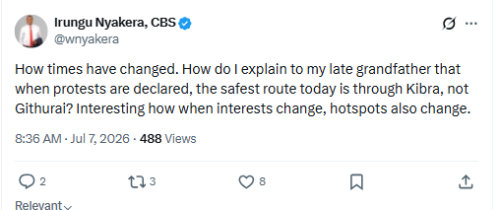
In a statement shared via his official X account on Tuesday, July 7, 2026, Nyakera argued that Kibra is now safer than Githurai during protests.
“How times have changed. How do I explain to my late grandfather that when protests are declared, the safest route today is through Kibra, not Githurai?” Nyakera posed.
You Might Also Like

“Interesting how when interests change, hotspots also change.”
A symbolic comparison
Nyakera’s comparison touches on two of Nairobi’s most politically significant constituencies.
For years, Kibra was widely regarded as the heartland of opposition politics, particularly during the leadership of former Prime Minister Raila Odinga. Major demonstrations organised by the Orange Democratic Movement (ODM) often drew large crowds from the constituency, making it one of the capital’s most closely watched areas during periods of political unrest.
Githurai, on the other hand, has historically been regarded as safe during protests due to the previous administrations that have been led by presidents from the Mt Kenya region.
Nyakera’s remarks suggest that those historical patterns have shifted, with Githurai emerging as one of the areas experiencing heightened tension during recent protests while Kibra has remained comparatively calmer.
Security heightened for Saba Saba
His comments came as police mounted an extensive security operation across Nairobi ahead of this year’s Saba Saba demonstrations.
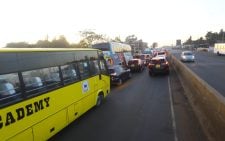
Roadblocks were erected along major highways leading into the Central Business District, including Thika Road, Mombasa Road, Jogoo Road, Lang’ata Road and Uhuru Highway.
Motorists experienced hours-long traffic jams as officers screened vehicles and diverted traffic, while many commuters were forced to walk after public service vehicles were prevented from accessing parts of the city centre.

Anti-riot police were also deployed around Parliament, State House Road, Harambee Avenue and other strategic installations as authorities sought to prevent protesters from entering sensitive government areas.
Changing political dynamics
Since the formation of the broad-based government following the political rapprochement between President William Ruto and the late Raila Odinga, areas traditionally associated with ODM have witnessed fewer anti-government demonstrations than in previous years.
Conversely, several protests in recent months have drawn significant participation from parts of the Mt Kenya region and Nairobi’s eastern suburbs, reflecting growing political discontent in areas that overwhelmingly backed President Ruto during the 2022 General Election.
The impeachment of former Deputy President Rigathi Gachagua in 2024 further altered political alignments in the Mt Kenya region, with several leaders distancing themselves from the Kenya Kwanza administration and joining or expressing support for emerging opposition formations.
Saba Saba’s enduring significance
This year’s Saba Saba commemorations mark another chapter in a movement that traces its origins to July 7, 1990, when pro-democracy activists staged demonstrations demanding the restoration of multiparty democracy under the KANU government.
More than three decades later, the anniversary continues to serve as a platform for citizens to express concerns over governance, accountability, economic challenges and constitutional rights.
Author
Mustafa Juma
View all posts by Mustafa JumaLatest News






Advertisement
More on News