Hillary Kibiwott officially sets a new record, planting at least 23,000 trees in 24 hours
By Cynthia Lodite, April 23, 2026The Kenya Forest Service has confirmed Hillary Kibiwott’s official new record after planting twenty-three thousand three hundred and twenty six tress in twenty-four hours.
In a statement by the KFS on the official X account on Thursday, April 23, 2026, KFS announced that Kibiwott planted the trees at Kessup Forest Station in Elgeyo-Marakwet County.
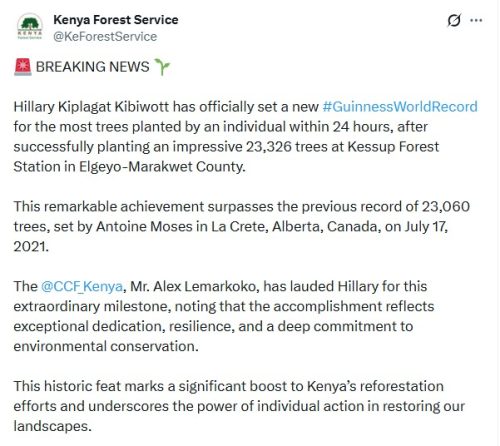
“Hillary Kiplagat Kibiwott has officially set a new #GuinnessWorldRecord for the most trees planted by an individual within 24 hours, after successfully planting an impressive 23,326 trees at Kessup Forest Station in Elgeyo-Marakwet County,” KFS stated.
According to the Kenya Forest Service, Kibiwott’s remarkable achievement surpasses the previous record of 23,060 trees, set by Antoine Moses in La Crete, Alberta, Canada, on July 17, 2021.
“The@CCF_Kenya, Mr Alex Lemarkoko, has lauded Hillary for this extraordinary milestone, noting that the accomplishment reflects exceptional dedication, resilience, and a deep commitment to environmental conservation,” KFS noted.
At the same time, the Service announced that this historic feat marks a significant boost to Kenya’s reforestation efforts and underscores the power of individual action in restoring our landscapes.
15 billion tree campaign
Kibiwotts’ records come as the government aims to plant 15 billion trees by 2032 as part of its ambitious 10-year climate restoration plan, but the number of seedlings actually established so far falls far short of this target.
The campaign, launched in December 2022 by President William Ruto, seeks to restore 10.6 million hectares of degraded landscapes and raise national tree cover to 30 per cent.
The move aimed at reducing greenhouse emissions, stopping and reversing deforestation, and restoring 5.1 million hectares of deforested and degraded landscapes.
This initiative unites governments, NGOs, businesses and individuals in a massive-scale nature restoration efforts to combat climate change and restore biodiversity. Hence the need to increase forest cover from the current 8.8 per cent to the required 10per cent before 2030, this will go along way in conserving the environment by purifying air and formation of rainfall which is significant in agricultural production.