Health PS Muthoni urges calm as govt confirms zero Ebola cases
By Ndiritu Wanjiru, May 29, 2026The Ministry of Health has made a formal statement concerning Ebola Virus Disease (EVD) and reminded the public of the importance of the transmission routes, symptoms, and key prevention measures to keep the country safe.
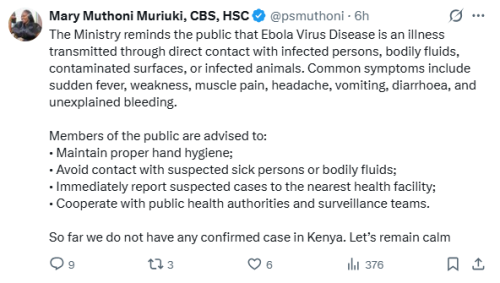
In a message on his X handle on Friday, May 29, 2026, Principal Secretary (PS) for Public Health and Professional Standards in the Ministry of Health, Mary Muthoni, confirmed that there are currently no confirmed Ebola cases in Kenya. She has, however, encouraged citizens to remain calm, but community vigilance and strict adherence to the health guidelines are essential to maintaining this virus-free status.
“The ministry reminds the public that Ebola virus disease is an illness transmitted through direct contact with infected persons, bodily fluids, contaminated surfaces, or infected animals. Common symptoms include sudden fever, weakness, muscle pain, headache, vomiting, diarrhoea, and unexplained bleeding,” Muthoni said.
“So far, we do not have any confirmed cases in Kenya. Let’s remain calm,” Muthoni added.
Symptoms of Ebola
Muthoni has further noted that Ebola is a serious and, at times, deadly disease, and the best defence is education. She has said that the illness is not airborne but can be spread by contact with infected people, animals (fruit bats and primates), body fluids or contaminated surfaces.
The PS has further noted that Ebola symptoms will occur within 2 to 21 days of exposure, sometimes starting with a sudden onset of fever, severe headache, muscle pain and extreme weakness. She said that as the disease advances, it may cause vomiting, diarrhoea and unexplained bleeding. Early identification of these signs and symptoms can save lives.
Government recommendation
The Ministry of Health recommends that everyone in the country adopt robust safety measures as a part of their daily life in order to make sure that the virus cannot establish itself in the country. One of these is maintaining proper hand hygiene – wash hands regularly with clean running water and soap or alcohol hand sanitiser. Also, there should be no physical contact by individuals with anyone who is suspected of being sick or with their body fluids.
The public is advised to report any signs and symptoms of the disease to the nearest health facility for prompt health assessment of the suspected patient. Last but not least, the ministry emphasises the need for complete cooperation with public health officials and surveillance teams at the border posts and medical centres.
Muthoni has said that there is no reason to be alarmed but called on the members of the public to ensure that they practise proper hygiene and stay informed, which will make Kenya safe.
She has advised the public to refer to official Ministry of Health sources for more information.
Uproar over American Ebola quarantine unit
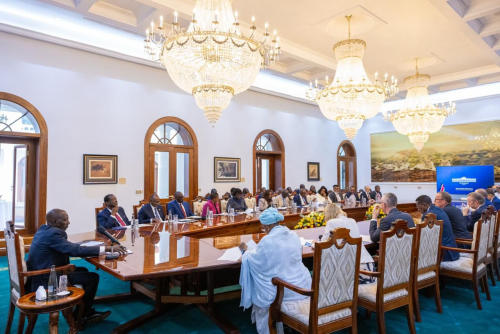
President William Ruto on Thursday, May 29, 2026, chaired a high-level meeting at State House, Nairobi, bringing together ambassadors, diplomats and representatives from international organisations to review Kenya’s preparedness measures.
The meeting included envoys from the United States, the United Kingdom, China, France, Germany, Japan, India and the European Union, alongside officials from the United Nations and other multilateral agencies.
Ruto said international cooperation remains critical in responding to cross-border health threats. “International solidarity is vital, particularly in times of multiple crises,” the president said.
According to the government, Kenya has intensified screening at 26 points of entry, where more than 58,000 travellers have so far been screened, with all suspected cases testing negative.
Authorities have also identified 17 isolation centres across the country and established a National Response Committee to coordinate surveillance, laboratory systems, public awareness campaigns and cross-border response measures.
The debate escalated following reports by The New York Times indicating that the United States was considering sending Americans exposed to Ebola to Kenya for observation and treatment instead of repatriating them directly to the US.
The reports triggered reactions from medical professionals and legal experts.
Kenya Medical Practitioners, Pharmacists and Dentists Union Secretary General Dr Davji Bhimji Atellah called for transparency regarding the reported plans and questioned why Kenya had been selected.
Law Society of Kenya President Charles Kanjama has also urged the government to reject any arrangement that could expose the country to additional risks. Kanjama argued that treatment facilities should remain closer to the outbreak epicentre in the eastern Democratic Republic of Congo and Uganda.