Govt steps in to save Cherangany Hills with a 10-year restoration plan
By Faith Lagat, April 17, 2026Kenya has launched the Cherangany Hills Ecosystem Restoration Programme (CHERISH), a 10-year initiative aimed at restoring one of the country’s key water towers affected by environmental degradation.
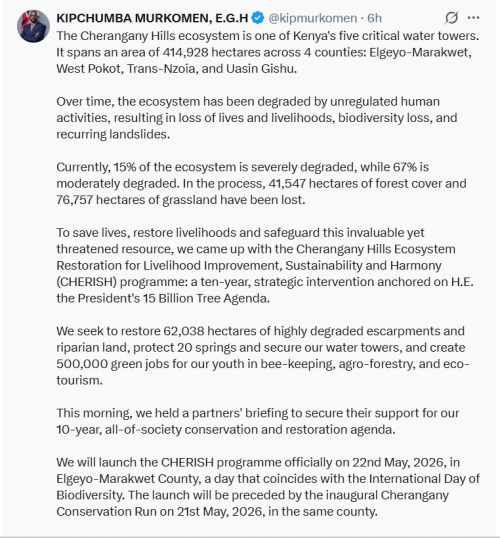
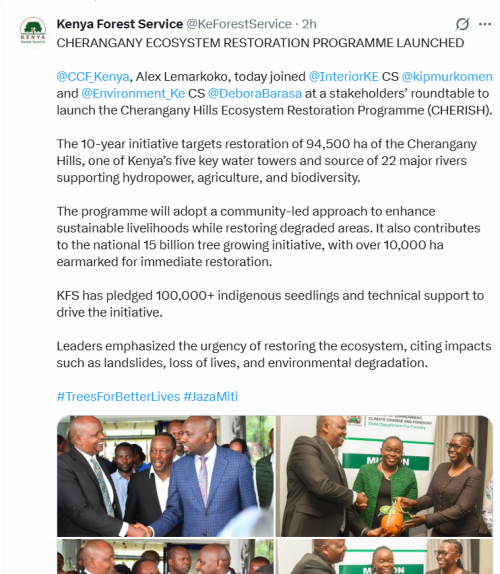
The programme was unveiled on Friday, April 17, 2026, during a stakeholders’ roundtable led by Chief Conservator of Forests Alex Lemarkoko, Interior Cabinet Secretary Kipchumba Murkomen and Environment, Climate Change and Forestry CS Deborah Barasa.
In his remarks shared on X, Murkomen said that the Cherangany Hills ecosystem is one of Kenya’s five critical water towers. It spans an area of 414,928 hectares across 4 counties: Elgeyo-Marakwet, West Pokot, Trans-Nzoia, and Uasin Gishu.
He added that the ecosystem has been affected by unregulated human activities leading to loss of biodiversity, livelihoods and recurring landslides.
Restoration targets and programme design
The CHERISH programme targets the restoration of 94,500 hectares through a community-based approach, with over 10,000 hectares prioritised for immediate intervention.
Murkomen said the initiative is anchored on the national 15 billion tree-growing agenda and is designed as a 10-year strategic intervention focusing on degraded escarpments and riparian areas.
“We seek to restore 62,038 hectares of highly degraded escarpments and riparian land, protect 20 springs and secure our water towers, and create 500,000 green jobs for our youth in bee-keeping, agro-forestry, and eco-tourism,” he stated.
The Kenya Forest Service has committed to supplying over 100,000 indigenous tree seedlings and providing technical support to communities involved in restoration efforts.
Extent of degradation and environmental impact
Murkomen noted that 15 per cent of the Cherangany Hills ecosystem is severely degraded, while 67 per cent is moderately degraded. He said the area has experienced loss of 41,547 hectares of forest cover and 76,757 hectares of grassland due to human activities such as farming expansion, illegal logging, charcoal burning, grazing and firewood collection.
He added that these pressures have contributed to biodiversity loss, soil erosion and recurring landslides across affected counties. The ecosystem spans Elgeyo-Marakwet, West Pokot, Trans-Nzoia and Uasin Gishu counties and supports 22 rivers that feed major water systems, including those draining into Lake Victoria and Lake Turkana basins.
Implementation, partnerships and launch plans
Murkomen said the programme will be implemented through collaboration between national and county governments, communities and development partners. He added that the initiative seeks to improve livelihoods while restoring ecological balance in the region.
He announced that CHERISH will be officially launched on May 22, 2026, in Elgeyo-Marakwet County, coinciding with the International Day of Biodiversity. The launch will be preceded by the inaugural Cherangany Conservation Run on May 21, 2026.